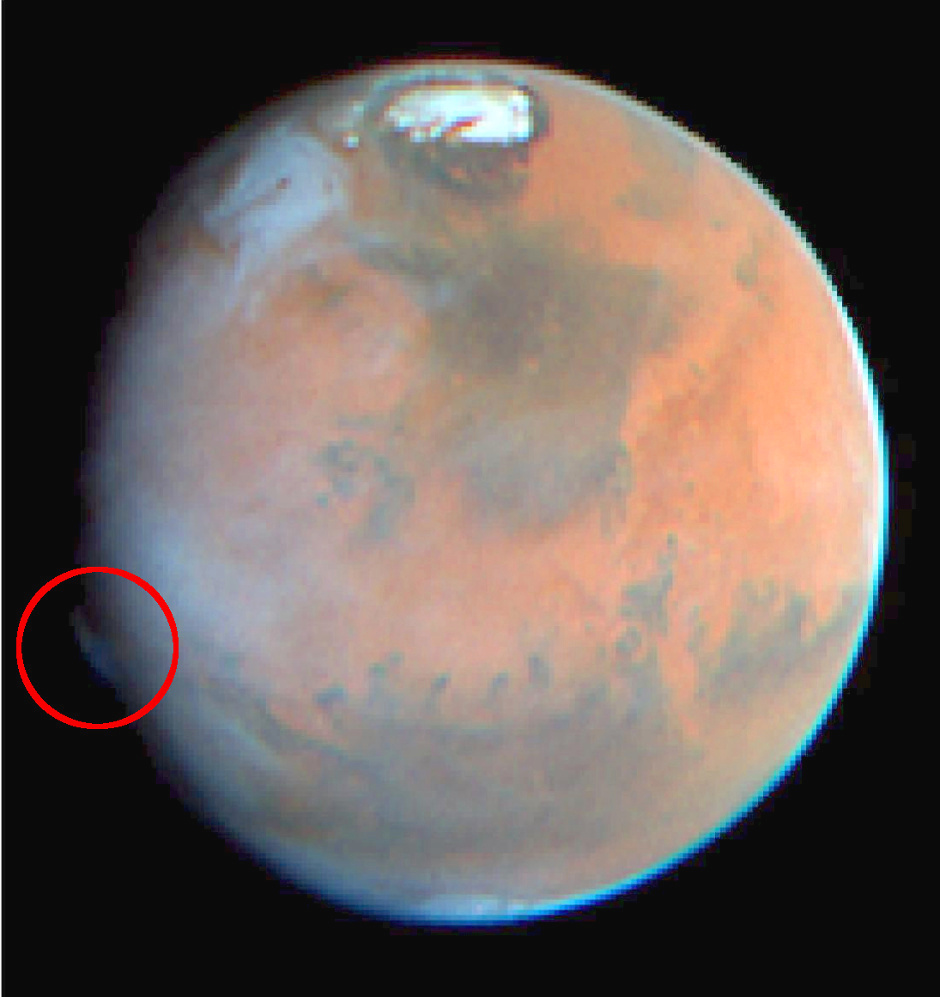
A curious plume-like feature was observed on Mars on 17th May 1997 by the Hubble Space Telescope. It is similar to the features detected by amateur astronomers in 2012, although it appeared in a different location. Image credit: JPL/NASA/STScIPlumes seen reaching high above the surface of Mars are causing a stir among scientists studying the atmosphere on the Red Planet. On two separate occasions in March and April 2012, amateur astronomers reported definite plume-like features developing on the planet.
The plumes were seen rising to altitudes of over 250 kilometres above the same region of Mars on both occasions. By comparison, similar features seen in the past have not exceeded 100 kilometres.
“At about 250 kilometres, the division between the atmosphere and outer space is very thin, so the reported plumes are extremely unexpected,” says Agustin Sanchez-Lavega of the Universidad del País Vasco in Spain, lead author of the paper reporting the results just published in the journal Nature.
GIF time-lapse animation of a mysterious plume-like feature (marked with yellow arrow) at the limb of the Red Planet. The observation in green light was made by astronomer W. Jaeschke 02:15—02:51 UT on 20th March 2012. The image is shown with the planet’s south pole to the top. Image credit: W. JaeschkeThe features developed in less than 10 hours, covering an area of up to 1000 x 500 km, and remained visible for around 10 days, changing their structure from day to day. None of the spacecraft orbiting Mars saw the features because of their viewing geometries and illumination conditions at the time.
However, checking archived Hubble Space Telescope images taken between 1995 and 1999 and of databases of amateur images spanning 2001 to 2014 revealed occasional clouds at the limb of Mars, albeit usually only up to 100 km in altitude. But one set of Hubble images from 17th May 1997 revealed an abnormally high plume, similar to that spotted by the amateur astronomers in 2012.
Scientists are now working on determining the nature and cause of the plumes by using the Hubble data in combination with the images taken by amateurs.
The top image shows the location of a mysterious plume on Mars, identified within the yellow circle (top image, south is up), along with different views of the changing plume morphology taken by W. Jaeschke and D. Parker on 21st March 2012. Image credit: W. Jaeschke and D. Parker“One idea we’ve discussed is that the features are caused by a reflective cloud of water-ice, carbon dioxide-ice or dust particles, but this would require exceptional deviations from standard atmospheric circulation models to explain cloud formations at such high altitudes,” says Agustin.
“Another idea is that they are related to an auroral emission, and indeed auroras have been previously observed at these locations, linked to a known region on the surface where there is a large anomaly in the crustal magnetic field,” adds Antonio Garcia Munoz, a research fellow at ESA’s ESTEC and co-author of the study.
The jury is still out on the nature and genesis of these curious high-altitude Martian plumes. Further insights should be possible following the arrival of ESA’s ExoMars Trace Gas Orbiter at the Red Planet, scheduled for launch in 2016.
NASA’s Mars Pathfinder probe dropped to the surface of Mars for an airbag-cushioned landing 20 years ago Tuesday, bouncing 15 times across an ancient flood plain before deploying a mobile robot to usher in two decades of uninterrupted Martian exploration.
Inner planets Mercury and Venus are currently approaching conjunction, low to the southwest horizon shortly after sunset. If you have an extra clear sky, then Mars completes the scene.
This image, taken with the Wide Field Planetary Camera 2 on board the NASA/ESA Hubble Space Telescope, shows the galaxy NGC 6052, located around 230 million light-years away in the constellation of Hercules. It is a “new” galaxy in the process of forming, the result of a merger between two separate galaxies that were gradually drawn together by gravity.