Equipment

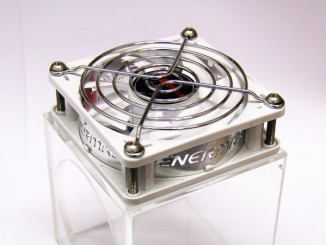
Geoptik CCD cooling fan

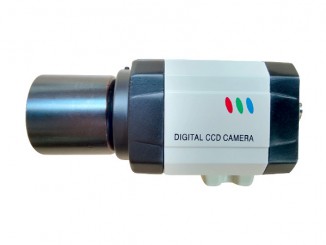
CCDs are incredible devices, gobbling photons that have travelled the vastness of space with great efficiency. Their Achilles heel is to also accept spurious signals from the immediate vicinity — within their own traitorous circuitry. Steve Ringwood investigates a CCD cooling chamber that will reduce a camera’s noise and increase its efficiency for both daytime and nocturnal imaging.

News

Pluto’s puzzling patterns and pits

It seems that the more we see of Pluto, the more fascinating it gets. This latest image, from the heart of Pluto’s heart feature, shows the plains’ enigmatic cellular pattern as well as unusual clusters of small pits and troughs. Adding to the intrigue is that even at this resolution of 250 metres, no impact craters are seen, testifying to the region’s extreme geologic youth.

Picture This

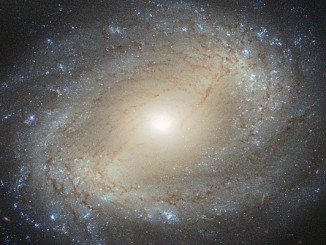
Elegant spiral galaxy hides a hungry monster

NGC 4639 is a beautiful example of a type of galaxy known as a barred spiral. It lies over 70 million light-years away in the constellation of Virgo and is one of about 1500 galaxies that make up the Virgo Cluster. But NGC 4639 also conceals a dark secret in its core — a massive black hole that is consuming the surrounding gas and known as an active galactic nucleus (AGN).

News

Closest northern views of Enceladus, Saturn’s cracked moon

NASA’s Cassini spacecraft has begun returning its best-ever views of the northern extremes of Saturn’s icy, ocean-bearing moon Enceladus. Scientists expected the north polar region of Enceladus to be heavily cratered, based on low-resolution images from the Voyager mission, but the new high-resolution Cassini images show a landscape of stark contrasts.

Observing

See the morning planet show and Mercury at its best

In the small hours of Friday, 16 October, innermost planet Mercury reaches its greatest westerly elongation from the Sun. For those of you in the UK with a flat, unobscured eastern horizon and willing to get up an hour before sunrise, the next few days provide your best opportunity to see Mercury from the Northern Hemisphere during 2015.

News

ALMA unveils rapid star formation in distant galaxies

In general, the larger a galaxy’s mass, the higher its rate of forming new stars. However, every now and then a galaxy will display a burst of newly-formed stars that shine brighter than the rest. Researchers using the Atacama Large Millimetre Array (ALMA) have found that galaxies forming stars at extreme rates 9 billion years ago were more efficient than average galaxies today.

Picture This

Zooming into the Coalsack Nebula

Dark smudges almost block out a rich star field in this new image of the Coalsack Nebula captured by the 2.2-metre telescope at ESO’s La Silla Observatory in Chile. This huge, dusky object forms a conspicuous silhouette against the bright, starry band of the Milky Way and has been known to people in the Southern Hemisphere for as long as our species has existed.

News

Comet’s tail may shed light on solar wind heating

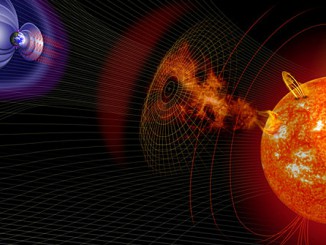
We can’t see the wind, but we can learn about it by observing things that are being blown about. And by studying changes in a comet’s bright tail of gas and ions, scientists are on the trail to solving two big mysteries about the solar wind — the supersonic outflow of electrically charged gas from the Sun’s million-degree upper atmosphere, or corona.