Archive
Visualising the Sun’s neighbourhood in 3-D
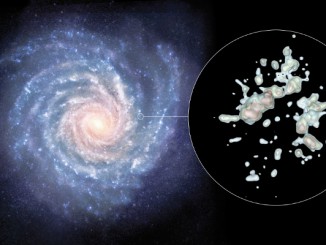
Astronomers have used modern techniques to create a 3-D visualisation of all of the O- and B-type stars within 500 parsecs (1,630 light-years) of the Sun using data from ESA’s Hipparcos satellite. This new visualisation uncovers evidence for new structures in the distribution of these nearby hot stars, and new and surprising theories of how those stars formed.
Discovery measures “heartbeats” of a distant galaxy’s stars
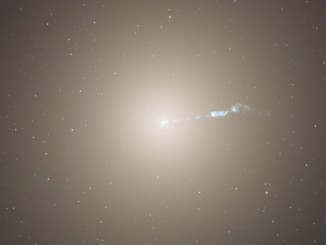
In many ways stars are like living beings. They’re born; they live; they die. And they even have a heartbeat. Near the end of their lifetime they begin to pulsate, increasing and decreasing their brightness by a large amount every few hundred days. Using a novel technique, astronomers have detected thousands of stellar “pulses” in the galaxy Messier 87 (M87). Their measurements offer a new way of determining a galaxy’s age.
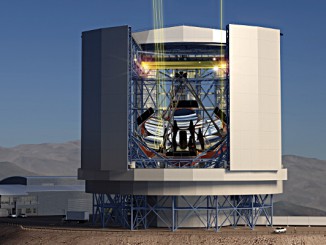
The Giant Magellan Telescope Organisation breaks ground in Chile
Leading scientists, senior officials, and representatives of an international consortium of universities and research institutions gathered on a remote mountaintop high in the Chilean Andes to celebrate groundbreaking for the Giant Magellan Telescope (GMT). The instrument is poised to become the world’s largest telescope when it begins early operations in 2021.
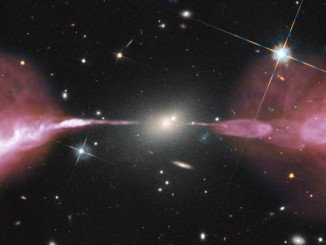
NASA’s Fermi finds hints of gamma-ray cycle in active galaxy
Astronomers using data from NASA’s Fermi Gamma-ray Space Telescope have detected hints of periodic changes in the brightness of a so-called “active” galaxy, whose emissions are powered by a supersized black hole. If confirmed, the discovery would mark the first years-long cyclic gamma-ray emission ever detected from any galaxy, which could provide new insights into physical processes near the black hole.
5,400mph winds hurtling around exoplanet
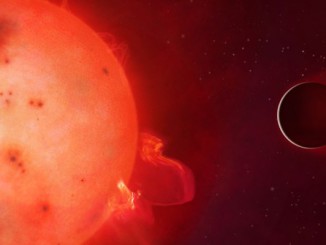
Wind speeds of over 2 kilometres per second have been discovered flowing around planet outside of our solar system. The University of Warwick discovery is the first time that a weather system on an exoplanet has been directly measured and mapped. The wind speed recorded is 20x greater than the fastest ever known on Earth, where it would be seven times the speed of sound.
Evidence for an impact event on main-belt asteroid Griseldis
The main-belt asteroid (493) Griseldis, that lies between the orbits of Mars and Jupiter, was probably hit by another object last March. The results were reported on 12 November at the 47th Annual Meeting of the Division for Planetary Sciences of the American Astronomical Society near Washington, DC.
Psychedelic Pluto
NASA’s New Horizons scientists made this false colour image of Pluto using a technique called principal component analysis to highlight the many subtle colour differences between Pluto’s distinct regions. The image data were collected by the spacecraft’s Ralph/MVIC colour camera on 14 July at 11:11 UTC, from a range of 22,000 miles (35,000 kilometres).
NASA’s Fermi satellite detects first gamma-ray pulsar in another galaxy
Researchers using NASA’s Fermi Gamma-ray Space Telescope have discovered the first gamma-ray pulsar in a galaxy other than our own. Known as PSR J0540-6919, the object sets a new record for the most luminous gamma-ray pulsar known. The pulsar lies in the outskirts of the Tarantula Nebula in the Large Magellanic Cloud, a small galaxy that is located 163,000 light-years away.