News

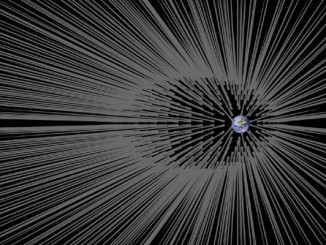
Earth might have hairy dark matter

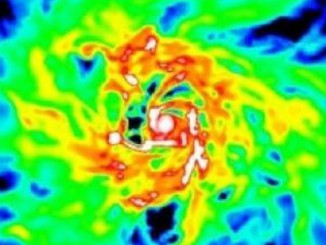
Dark matter is an invisible, mysterious substance that makes up about 27 percent of all matter and energy in the universe. A new NASA study publishing this week proposes that when a stream of dark matter particles goes through a planet, the planet’s gravity bends and focuses the particles into an ultra-dense filament, or “hair,” of dark matter. In theory, there should be many such hairs sprouting from Earth.


Picture This

Hubble views NGC 3610, a young elliptical galaxy with a disc

Elliptical galaxy NGC 3610 is the most prominent object in this amazing Hubble image — and a very interesting one at that! Discovered in 1793 by William Herschel, it was later found that this galaxy contains a disc. This is very unusual, as discs are one of the main distinguishing features of a spiral galaxy. And the disc in NGC 3610 is remarkably bright.

News

“Planetary Nebulae” receive more meaningful physical presence

Despite their name, planetary nebulae have nothing to do with planets. They were described as such by early astronomers whose telescopes showed them as glowing disc-like objects, but we now know that they represent the final stage of activity of stars like our Sun. A way of estimating more accurate distances to planetary nebulae dispersed across our Galaxy has just been announced.

Equipment

Howie Glatter Blug™

In order for a telescope to perform to theoretical limits its optical components must be perfectly aligned. With an optically fast Newtonian reflector this can be a challenge, but a laser collimator makes the task much easier. Steve Ringwood investigates Howie Glatter’s Blug™ — a charming contraction of ‘Barlowed collimation plug’.

Picture This

A day on Pluto, a day on Charon

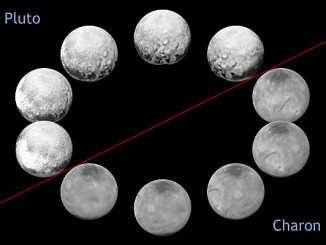
Pluto’s day is 6.4 Earth days long. The dwarf planet’s largest moon, Charon, also rotates once every 6.4 days as the two worlds are tidally locked to each another. This sequence of images from the Long Range Reconnaissance Imager (LORRI) and the Ralph/Multispectral Visible Imaging Camera on NASA’s New Horizons spacecraft shows us full rotations of the two bodies.