News


Now just ten weeks from opposition, Mars is growing in both apparent size and brightness in the pre-dawn sky as the distance between our two worlds decreases. On the morning of Wednesday, 16 March, around the onset of UK nautical twilight, the Red Planet passes just 0.15 degrees from double star Graffias in the constellation Scorpius.
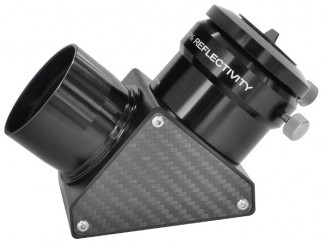
Steve Ringwood casts his expert eye over and into a 2-inch push-fit dielectric mirror diagonal for refractors and catadioptrics from Explore Scientific. This star diagonal delivers optical fidelity since it has a mirror that has been honed to 1/12th wave and reflects 99 percent of incoming light to the eyepiece.

Galaxy clusters are enormous collections of hundreds or even thousands of galaxies and vast reservoirs of hot gas embedded in massive clouds of dark matter. To learn more about clusters, including how they grow via collisions, astronomers have used some of the world’s most powerful X-ray, optical and radio telescopes. The name for this galaxy cluster project is the “Frontier Fields”.
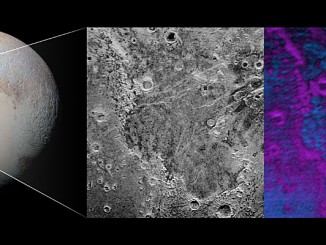
Far in the dwarf planet’s western hemisphere, scientists on NASA’s New Horizons mission have discovered what looks like a giant “bite mark” on Pluto’s surface. They suspect that the methane ice-rich surface on Pluto may be sublimating away into the atmosphere, exposing a layer of water-ice underneath.
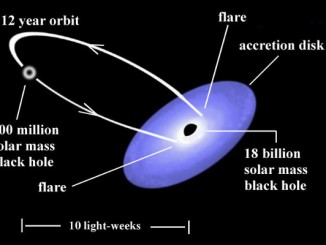
A recent observational campaign involving more than two dozen optical telescopes and NASA’s space-based SWIFT X-ray telescope allowed a team of astronomers to measure very accurately the rotational rate of one of the most massive black holes in the universe. The black hole powers a quasar called OJ 287 which lies about 3.5 billion light-years away from Earth.
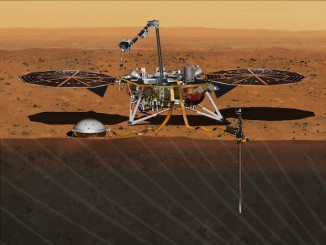
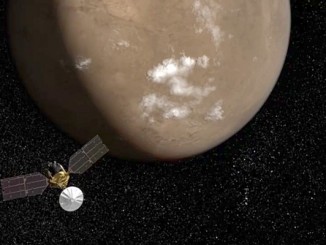
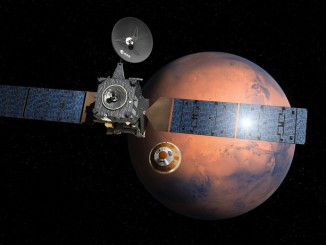
On 10 March 2006, NASA’s Mars Reconnaissance Orbiter (MRO) entered into orbit around the Red Planet. A decade later, with its six science instruments all still operating, MRO has delivered huge advances in knowledge about Mars, revealing in unprecedented detail a world that held diverse wet environments billions of years ago and remains dynamic today.
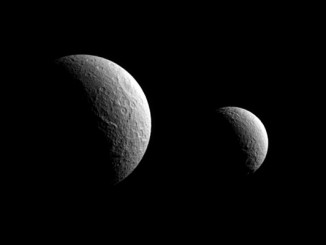
Similar in many ways, Saturn’s moons Tethys and Rhea (left and right, respectively) even share a discoverer: Giovanni Cassini, namesake of the NASA spacecraft that captured this view. Although somewhat different in size, Rhea (949 miles across) and Tethys (660 miles) are both composed largely of ices and are generally thought to be geologically inactive today.
© 2026 Nebula Press Ltd