News

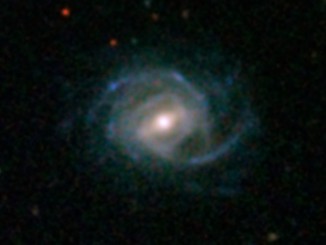
Astronomers discover colossal ‘super spiral’ galaxies

A strange new kind of galactic beast has been spotted in the cosmic wilderness. Dubbed “super spirals,” these unprecedented galaxies dwarf our own spiral galaxy, the Milky Way, and compete in size and brightness with the largest galaxies in the universe. The galaxies have long hidden in plain sight by mimicking the appearance of typical spirals.
Picture This

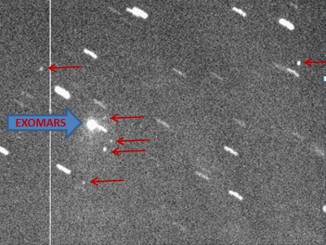
ExoMars spotted in space en route to Red Planet

On 14 March, the ExoMars spacecraft and Schiaparelli lander were lofted into orbit by a Proton rocket, starting a seven-month journey to the Red Planet. For the ExoMars launch, ESA’s near-Earth object (NEO) coordination centre in Italy organised a successful international campaign for ground-based optical observations of the departing spacecraft.

News

VLA reveals earliest stages of planet formation

New images of a young star called HL Tauri made with the Karl G. Jansky Very Large Array (VLA) reveal what scientists think may be the very earliest stages in the formation of planets. The scientists used the VLA to see unprecedented detail of the inner portion of a dusty disc surrounding the star, some 450 light-years from Earth.

News

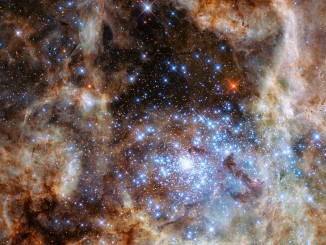
Hubble unveils monster stars in the Tarantula Nebula

Astronomers using the unique ultraviolet capabilities of the NASA/ESA Hubble Space Telescope have identified nine monster stars with masses over 100 times the mass of the Sun in the star cluster R136, located in the Tarantula Nebula within the Large Magellanic Cloud. This makes it the largest sample of very massive stars identified to date.

News

Spectacular green fireball seen over UK

Observers across the British Isles report a fireball seen shortly before 3:17am GMT on 17 March. The UK Meteor Observation Network’s monochrome camera in Church Crookham, Hampshire also recorded the spectacular event, which lasted for several seconds and was seen for hundreds of miles.

News

Students map Milky Way with dwarf stars

Two astronomy students from Leiden University have mapped the entire Milky Way Galaxy in dwarf stars for the first time. They show that there are a total of 58 billion dwarf stars, of which seven percent reside in the outer regions of our galaxy. This result is the most comprehensive model ever for the distribution of these stars.

News

Unexpected changes of bright spots on Ceres discovered

New and very precise observations using the HARPS spectrograph with the ESO 3.6-metre telescope in Chile have not only detected the motion of the enigmatic bright spots on Ceres due to the dwarf planet’s rotation about its axis, but also found unexpected additional variations suggesting that the material of the spots is volatile and evaporates in sunlight.

News

How to detect colliding black holes

Shortly to be honoured with a Bessel Award of the Humboldt Foundation, Professor Harald Pfeiffer’s research into solving Einstein’s equations on supercomputers not only helps us locate black holes in the Universe and determine their size, but his calculations also teach us how space-time behaves when it is warped by black holes.