News

Evidence builds for ancient under-ice volcanoes on Mars

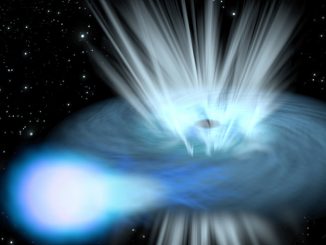
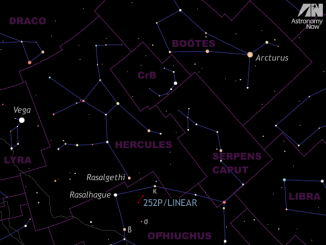
Volcanoes erupted beneath an ice sheet on Mars billions of years ago, far from any ice sheet on the Red Planet today, new evidence from NASA’s Mars Reconnaissance Orbiter suggests. The research about these volcanoes helps show there was extensive ice on ancient Mars. Such an environment combining heat and moisture could have provided favourable conditions for microbial life.

News

Planet Nine: a world that shouldn’t exist

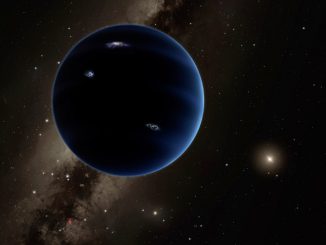
Earlier this year scientists presented evidence for Planet Nine, a Neptune-mass planet in an elliptical orbit 10 times farther from our Sun than Pluto. New research examining theories how this planet could end up in such a distant orbit finds that most scenarios have low probabilities. Therefore, the presence of Planet Nine remains a bit of a mystery.

Picture This

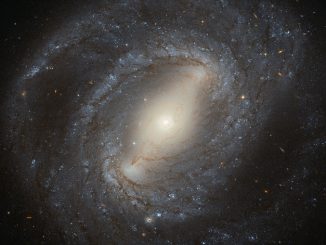
Hubble spies the archetypal barred spiral galaxy

Discovered in 1784 by William Herschel, NGC 4394 is the archetypal barred spiral galaxy, with bright spiral arms emerging from the ends of a bar that cuts through the galaxy’s central bulge. Some 55 million light-years from Earth, the galaxy lies in the constellation of Coma Berenices. NGC 4394 is considered to be a member of the Virgo Cluster.

News

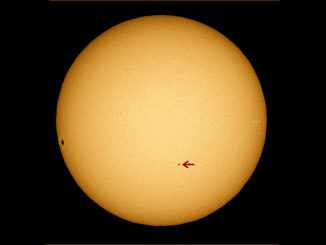
Rare transit of Mercury to take place on 9 May

On Monday, 9 May there will be a rare transit of Mercury, when the innermost planet in our solar system will pass directly between the Earth and the Sun. The last time this happened was in 2006. With a properly filtered telescope and fine weather, the entire 7½-hour event can be seen from the British Isles.

Equipment

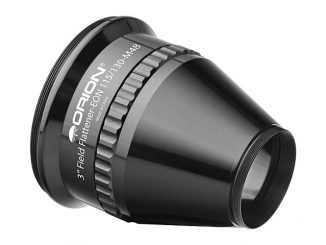
Orion 3″ field flattener for EON 115/130 EDT refractors

Steve Ringwood reviews a dedicated 3″ field flattener designed for use with Orion’s EON 115/130 EDT refractors. One side of the field flattener threads on to the 3″ focuser, whilst the other offers a wide M48 thread that enables fixture of DSLRs, etc. without the vignetting possible with smaller M42 designs — particularly when deployed with full frame sensors.

Observing

See Comet 252P/LINEAR in a moonless sky

On the afternoon of 21 March, Comet 252P/LINEAR brushed by Earth just 14 lunar distances away. The comet’s separation from Earth now exceeds 20 million miles, but it’s still a suitable target for binoculars and small telescopes — if you know exactly where to look. Here’s our UK observing guide for 252P/LINEAR in the constellation Ophiuchus between midnight and moonrise over the coming week.