Picture This

A death star’s ghostly glow

The eerie glow of a dead star, which exploded long ago as a supernova, reveals itself in this NASA Hubble Space Telescope image of the Crab Nebula in the constellation of Taurus. But don’t be fooled. The ghoulish-looking object still has a pulse. Buried at its centre is the star’s telltale heart — a neutron star which beats with rhythmic precision.
News

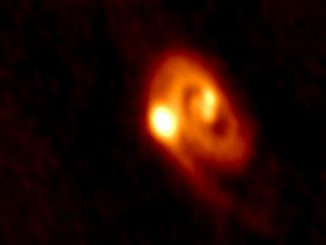
ALMA witnesses the birth of a triple-star system

A rare triple-star system surrounded by a disc with a spiral structure has been discovered by a global team of researchers. Recent observations from the Atacama Large Millimetre / submillimetre Array (ALMA) resulted in the discovery, lending support for evidence of disc fragmentation — a process leading to the formation of young binary and multiple star systems.

News

Unexpected gaseous haloes detected around distant quasars

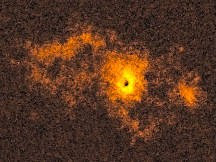
An international team of astronomers has discovered glowing gas clouds surrounding distant quasars. The new survey of these active galaxies indicates that haloes around quasars are far more common than expected. The properties of the haloes in this surprising find are also in striking disagreement with currently accepted theories of galaxy formation in the early universe.

News

Hotspots in Cygnus A: an active galactic nucleus

Newly obtained radio images of the dramatic bipolar jets of charged particles being ejected from the nucleus of galaxy Cygnus A were able to resolve hotspots in the jets at the places where they impact the surrounding medium. A bright radio galaxy such as this can beam as much as one trillion solar luminosities of radiation into space at those wavelengths.

Picture This

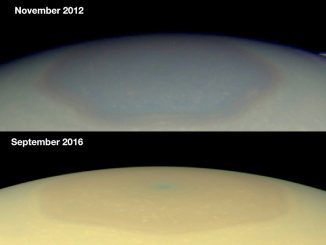
The changing colours of Saturn’s north pole

Scientists are investigating potential causes for the change in colour of the region inside the north-polar hexagon on Saturn, thought to be an effect of the planet’s seasons. In particular, the change to a more golden hue may be due to the increased production of photochemical hazes in the atmosphere as the north pole approaches summer solstice in May 2017.