Picture This

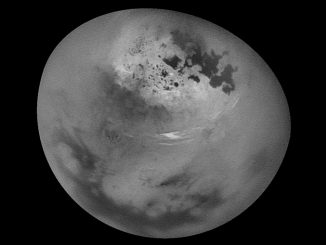
Cassini sees drifting summer clouds on Titan

NASA’s Cassini spacecraft watched clouds of methane moving across the far northern regions of Saturn’s largest moon, Titan, on 29 and 30 October 2016. Several sets of clouds develop, move over the surface and fade during the course of a movie sequence spanning 11 hours, with one frame taken every 20 minutes. These clouds are measured to move at a speed of about 14 to 22 miles per hour.

News

New theory of gravity might explain dark matter

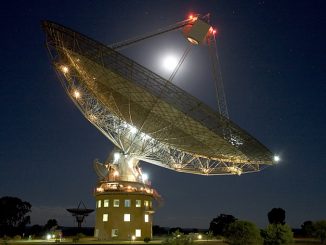
Emergent gravity is a new theory that might explain the curious motions of stars in galaxies. It predicts the exact same deviation of motions that is usually explained by invoking dark matter. Professor Erik Verlinde, renowned expert in string theory, publishes a new research paper today in which he expands his groundbreaking views on the nature of gravity.

Picture This

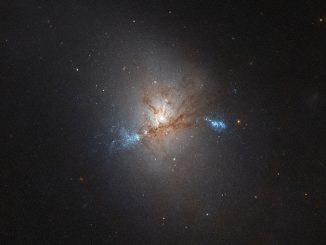
Hubble captures a galactic cannibal

This NASA/ESA Hubble Space Telescope image reveals NGC 1222, a galaxy with a rather eventful story to tell. NGC 1222 has been described as a peculiar example of a so-called lenticular galaxy, but one that exhibits very recent star formation on a huge scale — an event known as a starburst — due to having recently consumed two dwarf galaxies.

News

Interacting galaxies produce eye-shaped “tsunami” of stars

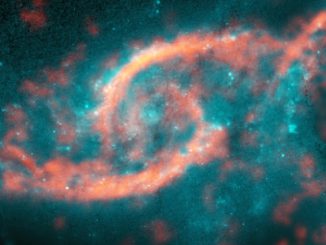
Astronomers using the Atacama Large Millimetre/submillimetre Array (ALMA) have discovered a tsunami of stars and gas that is crashing midway through the disc of a spiral galaxy known as IC 2163. This colossal wave of material — which was triggered when IC 2163 recently sideswiped another spiral galaxy dubbed NGC 2207 — produced dazzling arcs of intense star formation that resemble a pair of eyelids.