News

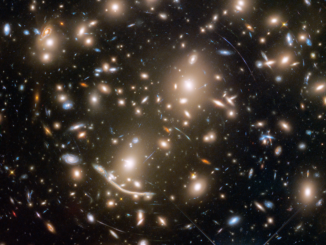
Like the quirky characters in the upcoming film Guardians of the Galaxy Vol. 2, NASA’s Hubble Space Telescope has some amazing superpowers, specifically when it comes to observing galaxies across time and space. One stunning example is galaxy cluster Abell 370, which contains a vast assortment of several hundred galaxies tied together by the mutual pull of gravity.

In the small UK hours of Sunday 14 May, the rising 17-day-old Moon in the southeast lies just 2.4 degrees to the upper-left of Saturn, meaning that the pair will comfortably fit in the same field of view of a typical 10×50 binocular. The ringed planet is now about a month from opposition, so now’s the time to hone your observing skills.


Observers with a clear sky to the south as darkness falls on Sunday 7 May can see the 12-day-old waxing gibbous Moon and planet Jupiter separated by little more than twice the width of a full Moon. For telescope owners in the UK, this is a night where you can also see Jupiter’s Great Red Spot and the planet’s four large Galilean moons.


In celebration of the 27th anniversary of the launch of NASA’s Hubble Space Telescope on April 24, 1990, astronomers used the legendary telescope to take a portrait of a stunning pair of spiral galaxies. This starry pair offers a glimpse of what our Milky Way galaxy would look like to an outside observer.
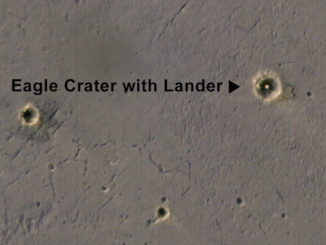
NASA has released the first high-resolution aerial colour image of the Opportunity rover’s landing site on a sprawling Martian plain, where the airbag-cushioned robot fortuitously rolled into a Eagle Crater in January 2004, putting its scientific instruments face-to-face with a block of sedimentary rock that gave ground teams confirmation Mars was once a warmer, wetter, and habitable planet.
© 2026 Nebula Press Ltd