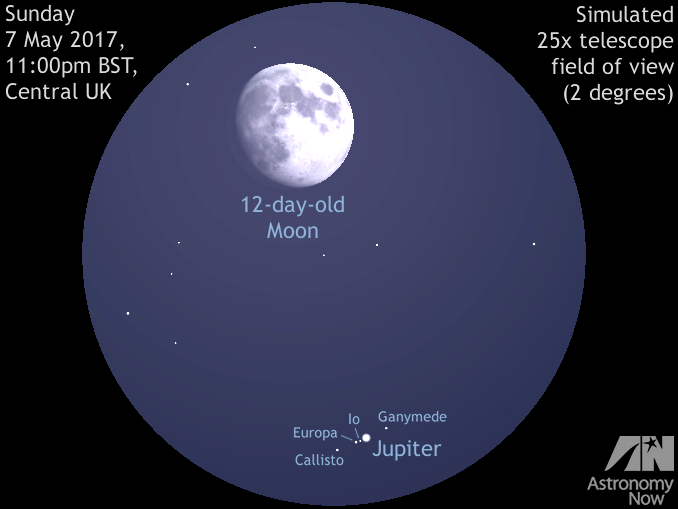
At 11pm BST on Sunday 7 May, the 12-day-old gibbous Moon lies just 1.3 degrees above Jupiter, the Solar System’s largest planet. In this simulated 25x magnification telescopic view that spans 2 degrees, the configuration of Jupiter’s four Galilean moons is also shown. Note that this is an erect image view (as in a high power binocular), so east is to the left. AN graphic by Ade Ashford.Observers in Western Europe looking to the south around 11pm local time on Sunday 7 May have a treat in store. If skies are clear you can see the 12-day-old waxing gibbous Moon pass little more than a degree north of largest planet Jupiter in the constellation of Virgo. For observers in the heart of the British Isles, this beautiful conjunction occurs 33 degrees (about one and a half spans of an outstretched hand at arm’s length) above the southern horizon when the pair are highest in the sky.
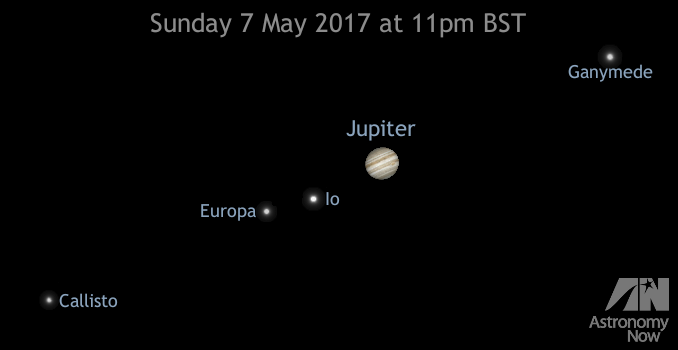
Now a month past opposition, magnitude -2.4 Jupiter is still a commanding presence as darkness falls, the brightest object in the evening sky aside from the Moon. The planet’s angular size just exceeds 43 arcseconds, meaning that a telescope magnification of just 42× is sufficient to enlarge it to the same apparent size as the adjacent Moon appears to the unaided eye.This simulated erect-image telescope view shows the Galilean moons visible this night. From east to west (left to right) they are Callisto, Europa, Io and Ganymede — the latter being the sole moon to the west of Jupiter. Note that in a reflecting telescope (Newtonian/Dobsonian), refracting telescope or catadioptric (Maksutov- or Schmidt-Cassegrain) with a star diagonal, east is to the right of the eyepiece view, so this graphic needs to be mirrored horizontally. AN graphic by Ade Ashford.If you possess a quality 3-inch (7.6-cm) aperture telescope or larger capable of magnifying 100× or more, Jupiter displays not only its four Galilean moons — Io, Europa, Ganymede and Callisto — on 7 May, but also the planet’s Great Red Spot (GRS).
The GRS transits — that is, it crosses an imaginary line joining Jupiter’s north and south poles — at 10:42pm BST (21:42 UT). Jupiter’s rapid rotation soon carries the Great Red Spot away from the planet’s meridian, but it remains on show until about midnight as seen from the UK.
Visibility predictions for Jupiter’s Great Red Spot and Galilean moons may also be obtained via our interactive Almanac. To see the events for any given day, ensure that the ‘Add phenomena of Jupiter?’ checkbox is ticked. Like the GRS predictions, all Galilean moon phenomena are in Universal Time (UT), so add one hour for current UK events. For help using the Almanac, see this article.
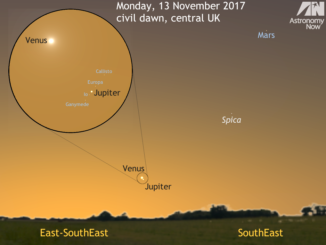
At the beginning of civil twilight on Monday, 13 November, observers in Western Europe and the British Isles should seek out a viewing location offering an unobstructed view very low to the southeast horizon to see brightest planet Venus and largest planet Jupiter separated by little more than half the width of a full Moon.
As it orbits Jupiter, the icy surface of Europa heaves and falls with the changing pull of its parent planet’s gravity, creating enough heat to likely support a global ocean beneath the Jovian moon’s solid shell. Experiments by geoscientists suggest that this process, called tidal dissipation, could create far more heat in Europa’s ice than scientists had previously assumed.
Spectacular views from a NOAA space weather observatory show the sunlit far side of the moon crossing the face of the Earth from a distant vantage point a million miles away.