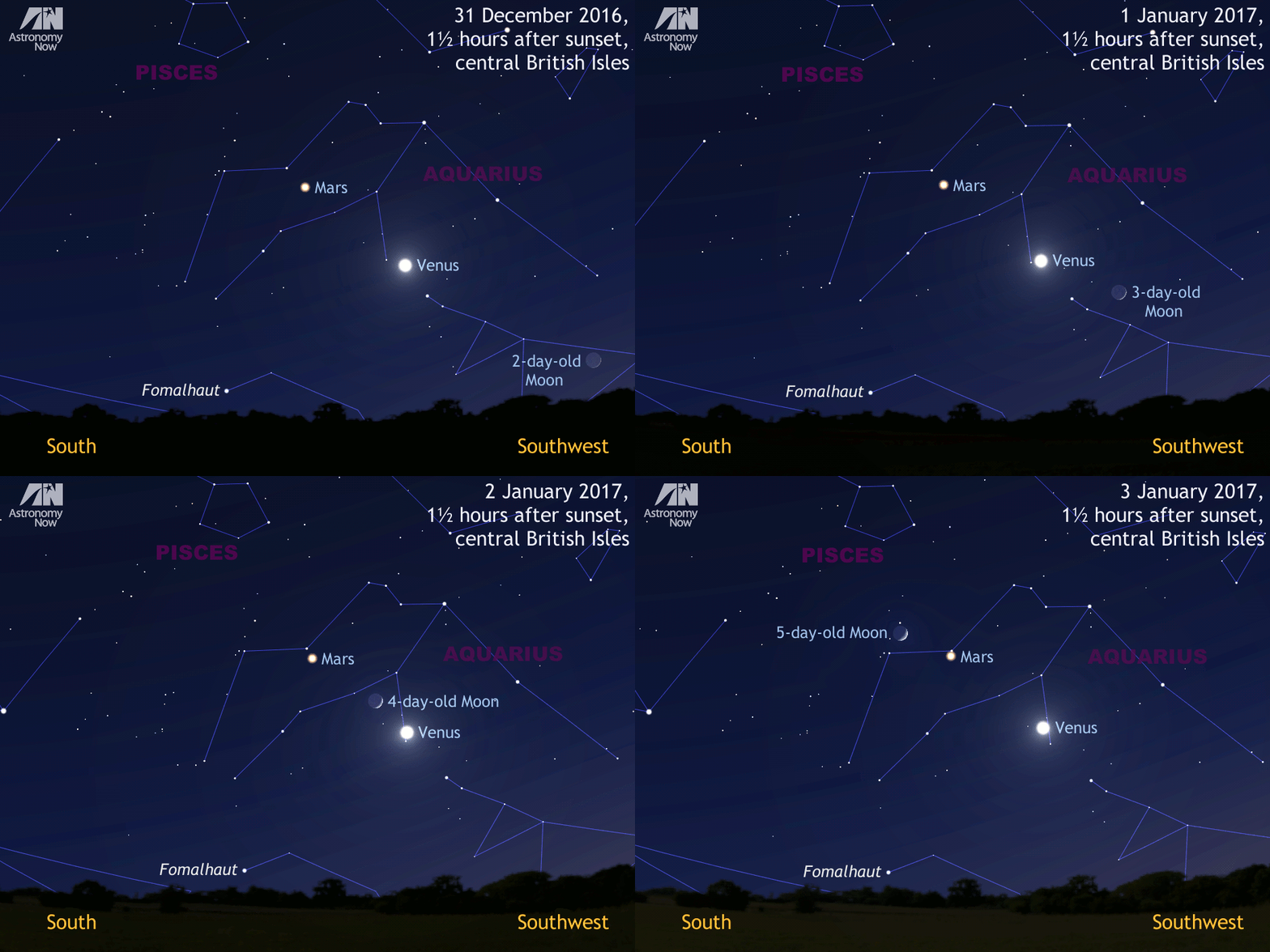
This looping animation shows the waxing young crescent Moon’s nightly motion at dusk through the zodiacal constellations of Capricornus and Aquarius from 31 December 2016 to 3 January 2017, passing dazzling planet Venus and first-magnitude Mars along the way. Too faint to be seen in this naked-eye view spanning 45 degrees (or twice the span of an outstretched hand at arm’s length) is outermost planet Neptune, which passes just 0.02 degrees (1.2 arcminutes) from Mars around 7h UT on 1 January. See the the text and telescope view below for more information. AN graphic by Ade Ashford.As 2016 draws to a close, a planetary gathering is taking place in the constellation of Aquarius at dusk. Venus is the dazzling magnitude -4.3 ‘star’ low in the south-southwest as twilight fades to dark, while first-magnitude Mars lies some 12 degrees (about half the span of an outstretched hand at arm’s length) to Venus’ upper left. As illustrated above, the young crescent Moon also joins the show for a few nights starting New Year’s Eve. But unseen to the naked eye yet readily viewed in small telescopes, outermost planet Neptune is currently drawing toward a much closer conjunction with the Red Planet in the small hours of New Year’s Day.
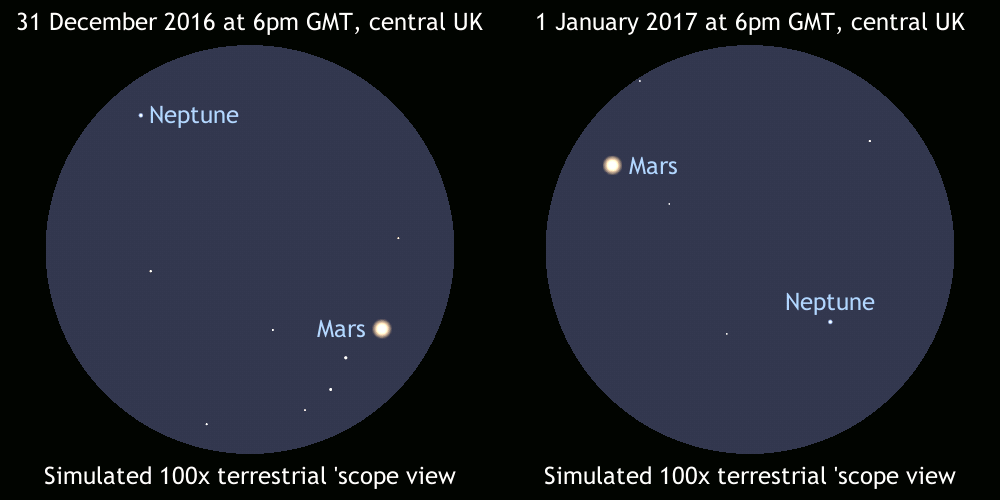
This looping animation shows the changing configuration of Mars and Neptune as seen in a 100x magnification terrestrial telescope (so the view is north up and east to the left) around 6pm GMT on the nights of 31 December 2016 and 1 January 2017 as viewed from the British Isles. On New Year’s Eve, UK observers can see the planets separated by about 0.4 degree; Mars and Neptune will be ⅓ degree apart the following night. Background field stars to magnitude +11 are also shown. Users of Newtonian/Dobsonian ‘scopes should rotate the view 180°, while refractor and catadioptric (Schmidt- and Maksutov-Cassegrain) owners using a star diagonal should mirror the view left-right. AN graphic by Ade Ashford.Both Mars and Neptune will be below the UK horizon when they appear to brush by just 1.2 arcminutes (0.02 degrees) apart around 7h UT on 1 January 2017, but the pair may be seen in close proximity on the early evenings of New Year’s Eve and New Year’s Day.
If you are fortunate to have clear skies over the next two nights and get a chance to contemplate this juxtaposition through a telescope, reflect on the fact that magnitude +7.9 outermost planet Neptune is 4.56 billion kilometres (2.83 billion miles) away from Earth, or 18½ times farther away than magnitude +0.9 Mars. The Red Planet is, therefore, more than six-hundred times brighter than its distant planetary sibling during their epic close encounter. In a high-power telescope, Mars shows a small 5.7-arcsecond-wide disc, while Neptune’s is just 2.2 arcseconds across.
The view from North America
By the time astronomical twilight fades to dark in New York, NY on New Year’s Eve (~6:16pm local time), Neptune and Mars lie just ¼ degree (14 arcminutes) apart. Some three hours later, when darkness falls in Los Angeles, CA (6:23pm local time) on the west coast, the separation of the two planets will have shrunk to 8.4 arcminutes. At this time (02:23UT on 1 January 2017) and for a few hours hence, Mars and Neptune will be visible in the same field of view of telescopes employing magnifications of 300x or more.
The view from Australasia
By 10:30pm local time on the first night of 2017, the summer sky of the New Zealand capital will be dark enough to view Mars and Neptune just 4.9 arcminutes — less than one-tenth of a degree — apart low in the west. Some 1¼ hours later in the Australian capital (9:45pm local time), the sky will be sufficiently dark to see that the separation of the two planets has grown to 7.1 arcminutes.
Wherever you find yourself in the world, we wish you clear skies and a very happy, healthy and prosperous 2017!
Inside the magazine
For a comprehensive guide to observing all that is happening in this month’s sky, tailored to Western Europe, North America and Australasia, obtain a copy of the January 2017 edition of Astronomy Now.
NASA’s Curiosity Mars rover has used its drill to collect sample powder from inside a rock target called “Telegraph Peak.” Examining rock samples like these will help scientists understand how the ancient wet environment of Mars dried up.
Now just ten weeks from opposition, Mars is growing in both apparent size and brightness in the pre-dawn sky as the distance between our two worlds decreases. On the morning of Wednesday, 16 March, around the onset of UK nautical twilight, the Red Planet passes just 0.15 degrees from double star Graffias in the constellation Scorpius.