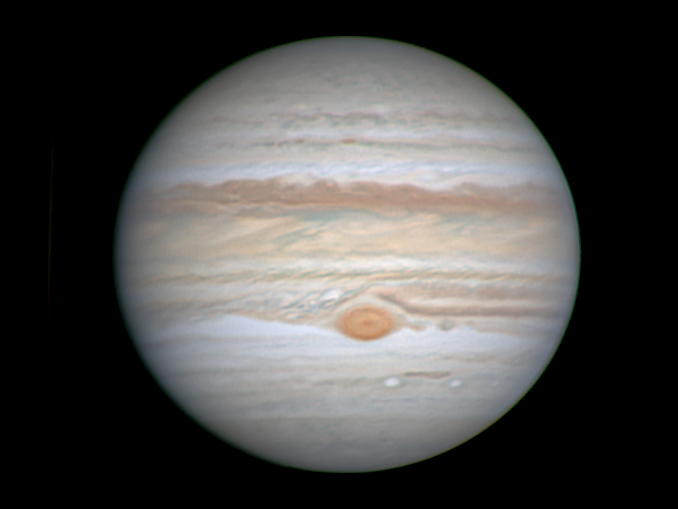
Australian amateur astronomer Anthony Wesley captured this detailed portrait of Jupiter with its Great Red Spot (GRS) shortly after transit on 22 July 2019 at 10:30 UTC. The GRS appears more elongated, so further flaking episodes could be about to occur. Image credit: Anthony Wesley, Rubyvale, Queensland, Australia.August opens with Jupiter 7½ weeks past opposition. The slow retrograde (westward) drift of the solar system’s largest planet through the constellation of Ophiuchus, the Serpent Bearer, slows until it reaches a stationary point on 11 August. Thereafter Jupiter resumes direct (eastward) motion with respect to the stars. The 9-day-old waxing gibbous Moon lies slightly less than four lunar diameters from the magnitude -2.4 planet late into the UK evening of Friday, 9 August.
Jupiter’s southerly declination has made this a challenging apparition for observers in the British Isles, where the planet struggles to attain a maximum altitude of 15 degrees above the southern horizon. For the heart of the UK, Jupiter is best placed around 15 minutes after sunset at the beginning of August and about 30 minutes before sunset by the end of the month. Consequently, the gas giant is already slipping lower in the south-southwest as twilight deepens, so don’t miss any viewing opportunities.
Great Red Spot
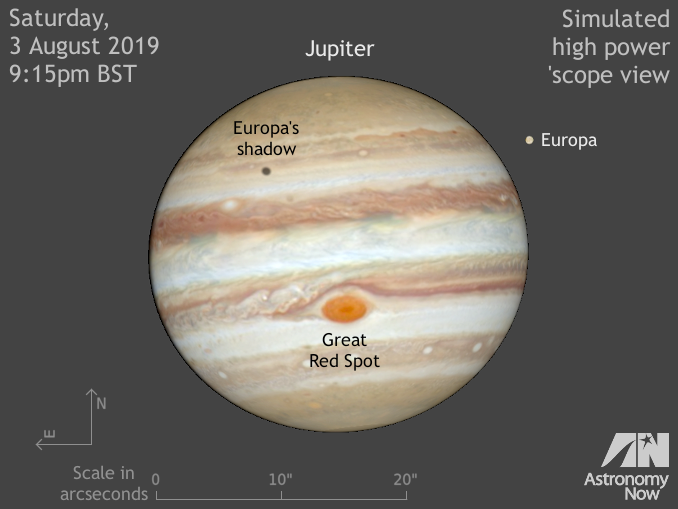
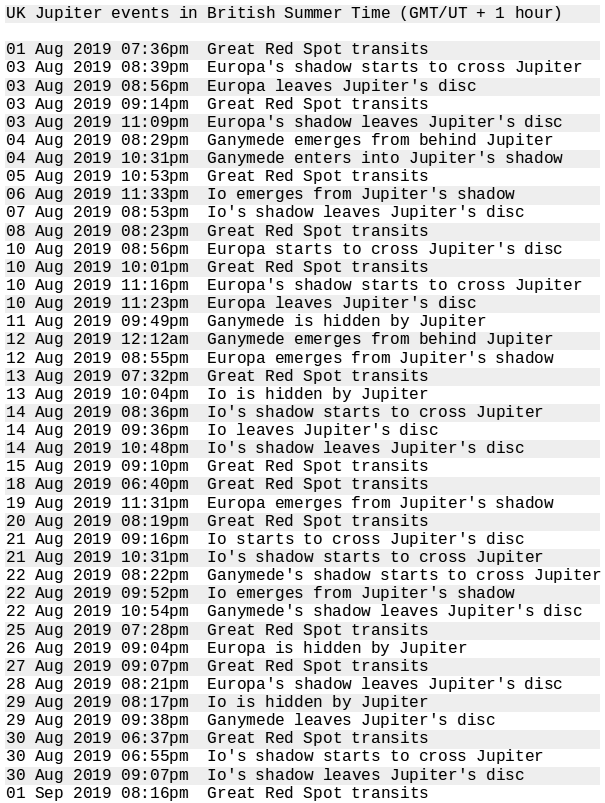
Despite Jupiter’s low altitude, on nights of good seeing there will be plenty to view in telescopes of 7.6-cm (3-inch) aperture and larger at magnifications of 100× or more. The planet’s Great Red Spot (GRS) is still a conspicuous brick red colour and maybe showing sights of renewed flaking activity, so do keep a keen eye on this Earth-sized anticyclonic storm in the Jovian atmosphere.Observers in the British Isles with clear skies and steady seeing at sunset on 3 August should have their telescopes trained on the southern meridian in readiness for Jupiter’s transit while a simultaneous transit of the planet’s Great Red Spot and a shadow transit of Galilean moon Europa is in progress. AN graphic by Ade Ashford.The table at the bottom of this page lists the best times to see the GRS for observers in the British Isles and those parts of Western Europe at a similar longitude (e.g., Central and Western France, Spain and Portugal). For other locations worldwide, be sure to visit our interactive online Almanac and ensure that the ‘Add phenomena of Jupiter?’ checkbox is ticked. The Almanac’s predictions are in Universal Time.
Jupiter’s Galilean moons
The following table also lists phenomena of the planet’s four large Galilean moons — Io, Europa, Ganymede and Callisto. These regularly pass in front of (or transit) Jupiter, are eclipsed by its shadow, or occulted (hidden) by their parent planet. The shadows of Io, Europa and Ganymede also appear as tiny black dots drifting across Jupiter’s cloud tops, but outermost moon Callisto appears to pass above or below Jupiter owing to the current inclination of its orbit to our line of sight.Phenomena of Jupiter and its bright Galilean moons visible from the British Isles and similar European longitudes (western France, Spain and Portugal) throughout August 2019. Note that all events are given in British Summer Time (BST), so subtract one hour to convert to Universal Time/GMT. Computation and data preparation: Ade Ashford/Guide.
At the beginning of civil twilight on Monday, 13 November, observers in Western Europe and the British Isles should seek out a viewing location offering an unobstructed view very low to the southeast horizon to see brightest planet Venus and largest planet Jupiter separated by little more than half the width of a full Moon.
The JunoCam imager aboard NASA’s Juno spacecraft has captured a stunning view of Jupiter’s north polar region, courtesy of citizen-scientist Björn Jónsson.
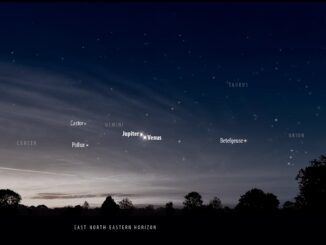
Get ready for a clash of the titans when Venus and Jupiter, the two brightest planets in our Solar System, come together for a dazzling event visible across the length and breadth of the UK in the early hours of Tuesday morning.