News

Ceres’ bright spots seen in striking new detail

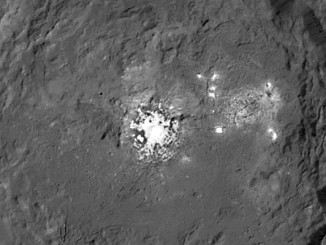
The brightest spots on the dwarf planet Ceres gleam with mystery in new views delivered by NASA’s Dawn spacecraft. These closest-yet views of 57-mile-wide impact crater Occator, with a resolution of 450 feet (140 metres) per pixel, give scientists a deeper perspective on these very unusual features — though the precise nature of the spots remains unknown.
Observing

See the Moon & Venus get close in the pre-dawn sky

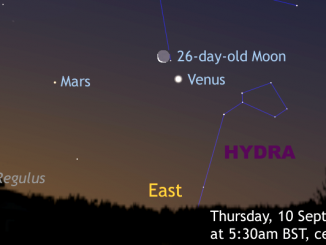
As dawn creeps across Western Europe on the morning of Thursday, 10 September, a close conjunction of the two brightest objects in the nighttime sky is taking place low in the east an hour before sunrise. So, set your alarm for 5:30am in the UK to see a beautiful juxtaposition of a 26-day-old waning crescent Moon and dazzling planet Venus in the twilight.

News

Citizen scientists make good black-hole hunters

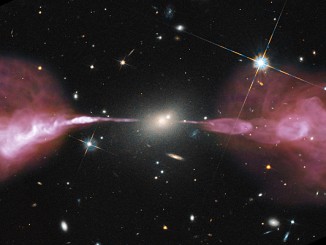
Trained volunteers are as good as professional astronomers at finding jets shooting from massive black holes and matching them to their host galaxies, research suggests. Scientists working on citizen science project Radio Galaxy Zoo developed an online tutorial to teach volunteers how to spot black holes and other objects that emit energy through radio waves.

Picture This

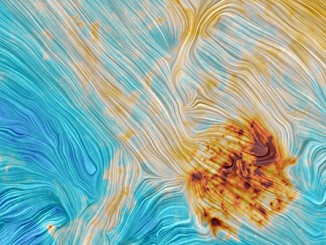
The Magellanic Clouds and an interstellar filament

Portrayed in this image from ESA’s Planck satellite are the Large and Small Magellanic Clouds, dwarf galaxies that are among the nearest companions of our Milky Way. The Large Magellanic Cloud, about 160,000 light-years away, is the large red and orange blob close to the centre of the image. The Small Magellanic Cloud lies some 200,000 light-years from us.

Picture This

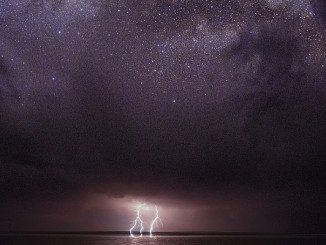
“Calm Before the Storm” by Julie Fletcher

Our twelfth nomination from the prestigious Insight Astronomy Photographer of the Year competition, an annual celebration of the most beautiful and spectacular visions of the cosmos by astrophotographers worldwide. The 2015 competition received 2700 spectacular entries from over 60 countries and the winners will be announced 17 September.

News

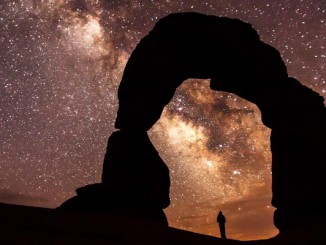
Bring on the night, say National Park visitors in new study

Natural wonders like tumbling waterfalls, jutting rock faces and banks of wildflowers have long drawn visitors to national parks and inspired efforts to protect their beauty. According to an American study published 4 September in Park Science, visitors also value and seek to protect a different kind of threatened natural resource in the parks: dark nighttime skies.

News

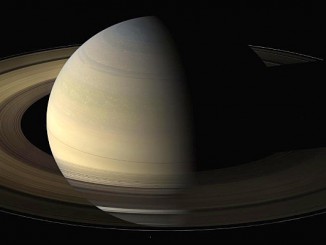
One of Saturn’s rings is not like the others

NASA’s Cassini mission scientists were watching closely when the Sun set on Saturn’s rings in August 2009. It was the equinox — one of two times in the Saturnian year when the Sun illuminates the planet’s enormous ring system edge-on — providing an extraordinary opportunity for the spacecraft to observe short-lived changes that reveal details about the nature of the rings.

Equipment

Celestron Ultima Duo eyepieces

While a vast body of space imagery lies just an internet click away, nothing compares to seeing an astronomical object in the eyepiece. But it is only natural that one should wish to capture such views with a camera. Steve Ringwood investigates Celestron’s ingenious Ultima Duo hybrid eyepieces intended to combine your visual and photographic needs in one package.

News

Hubble’s Andromeda Galaxy survey unlocks clues to star birth

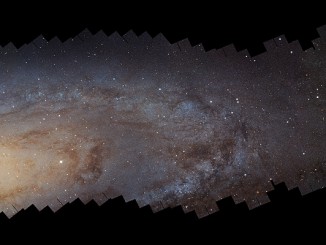
In a Hubble Space Telescope survey of 2,753 young, blue star clusters in the neighbouring Andromeda Galaxy (M31), astronomers have found that M31 and our own galaxy have a similar percentage of newborn stars based on mass. The intensive survey was a unique collaboration between astronomers and “citizen scientists,” volunteers who provided invaluable help in analysing the mountain of data from Hubble.