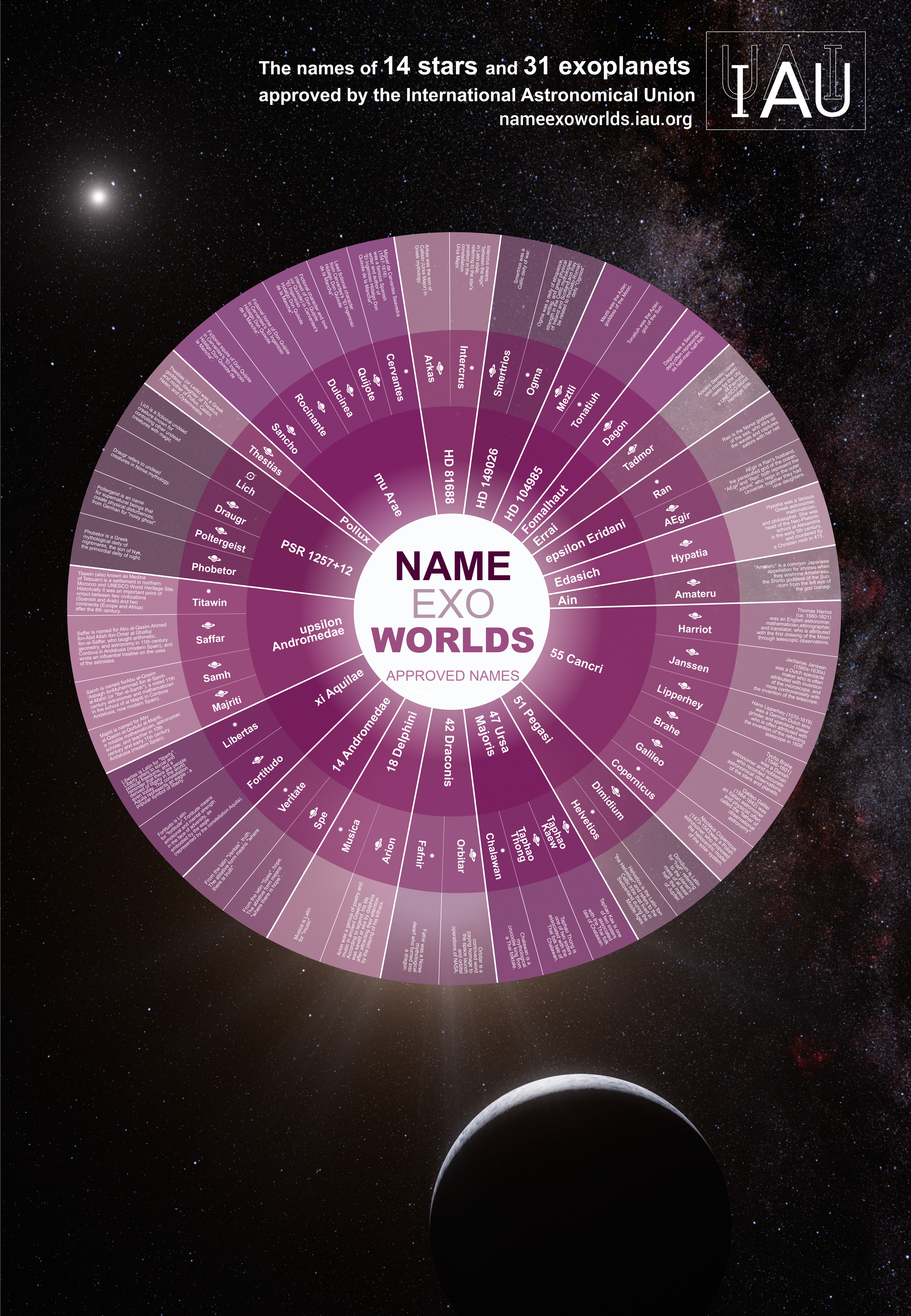
Although people have been naming celestial objects for millennia, the International Astronomical Union (IAU) is the authority responsible for assigning official names to celestial bodies. The NameExoWorlds contest provided the first opportunity for the public to name exoplanets, and their stars. The winning names are to be used freely in parallel with the existing scientific nomenclature, with due credit to the clubs or organisations that proposed them.Infographic displaying a breakdown of the winning names and brief descriptions of the chosen names. As announced on 15 December 2015, names for 31 exoplanets and 14 host stars, voted for by the public, were accepted and are to be officially sanctioned by the IAU. The winning names are to be used freely in parallel with the existing scientific nomenclature, with due credit to the clubs or organisations that proposed them. Click the graphic for a full-size version suitable for printing. Image credit: IAU.With voting concluding on 31 October 2015, a total of 573,242 votes from the public have contributed to the naming of 31 exoplanets and 14 host stars. Proposers of the winning names are to be awarded a plaque commemorating their contribution to astronomy and they will be given the exciting opportunity to name a minor planet.
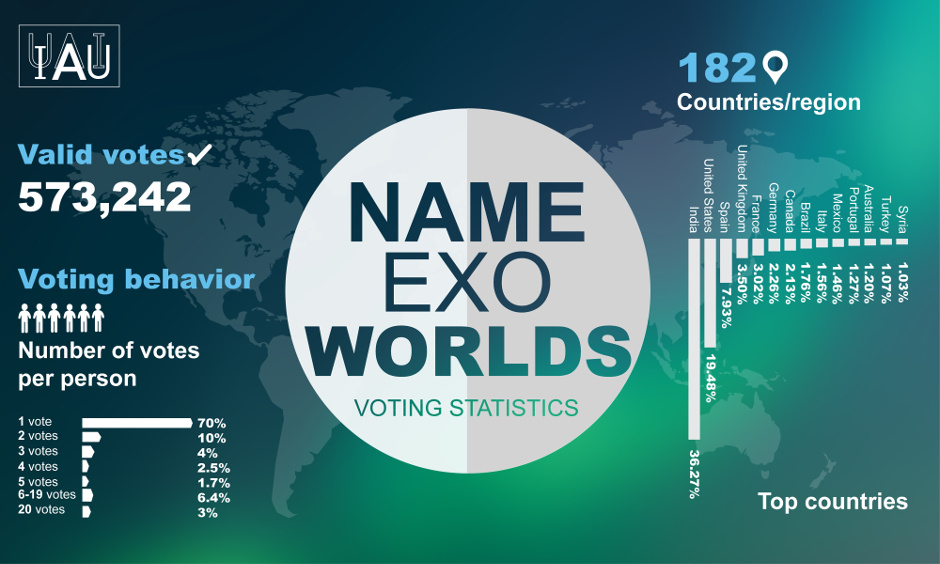
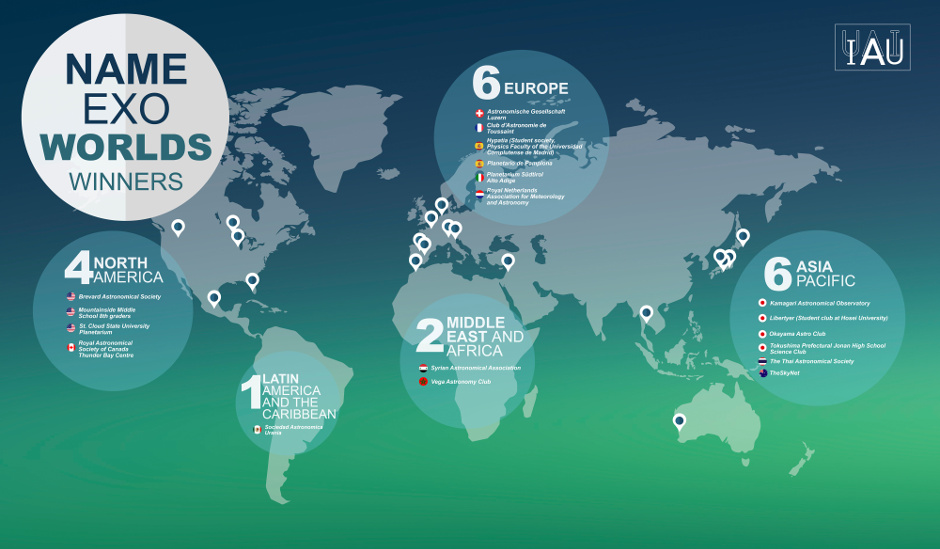
The public voted on the 274 proposed ExoWorld names submitted by a wide variety of astronomy organisations from 45 countries all over the world — these included amateur astronomy groups, schools, universities and planetariums. The successful entries were received from across the globe — four were received from North America (USA, Canada), one from Latin America (Mexico), two from the Middle East & Africa (Morocco, Syria), six from Europe (France, Italy, Netherlands, Spain, Switzerland), and six from Asia-Pacific (Australia, Japan, Thailand).Infographic displaying a breakdown of the votes per person and country/region in the IAU NameExoWorlds vote to name alien worlds. Image credit: IAU.The IAU Executive Committee Working Group on the Public Naming of Planets and Planetary Satellites validated all the individual cases of the winning names from the vote, as stipulated in the guidelines, and made appropriate modifications to the original proposals where necessary, in full agreement with the proposers.
However, after extensive deliberation, the Committee decided to annul the vote for one particular ExoWorld — tau Boötis — as the winning name was judged not to conform with the IAU rules for naming exoplanets. To this end, the IAU will organise a new contest to decide the name of tau Boötis in the future.Infographic displaying the locations of the winning proposals for the IAU NameExoWorlds vote are marked on a map of the world. Image credit: IAU.The newly adopted names take the form of different mythological figures from a wide variety of cultures from across history, as well as famous scientists, fictional characters, ancient cities and words selected from bygone languages.
The complete list of the results, including vote counts, proposers, and citations is published on the IAU NameExoWorlds website.
After a search for an outside funding source turned up empty, NASA plans to end observations with the Spitzer Space Telescope in January to conclude a 16-year mission that discovered exoplanets, studied galaxies in the ancient universe, and peered at planets and asteroids in our own Solar System.
On July 14th, NASA’s New Horizons spacecraft will flyby Pluto, offering the first close-up look at that small, distant world. You can help decide what names will be used on subsequent maps of the dwarf planet and its largest moon, Charon, as the SETI Institute announces the launch of its “Our Pluto” campaign.