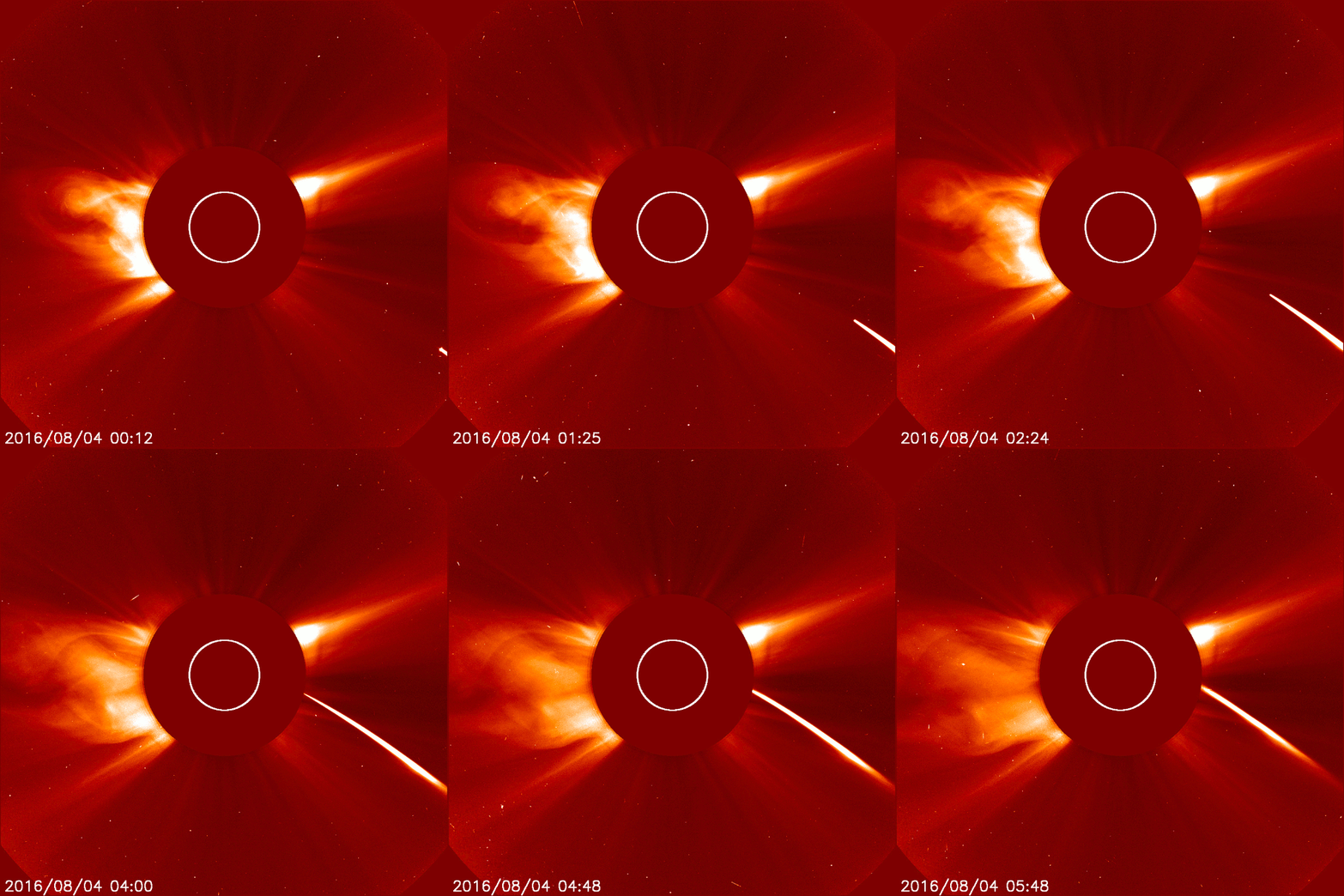
Image credit: ESA/NASA/SOHO/Joy Ng.ESA and NASA’s Solar and Heliospheric Observatory, or SOHO, saw a bright comet plunge toward the Sun on 3-4 August 2016, at nearly 1.3 million miles per hour. Comets are chunks of ice and dust that orbit the Sun, usually on highly elliptical orbits that carry them far beyond the orbit of Pluto at their farthest points. This comet, first spotted by SOHO on 1 August, is part of the Kreutz family of comets, a group with related orbits that broke off of a huge comet several centuries ago.
This comet didn’t fall into the Sun, but rather whipped around it – or at least, it would have if it had survived its journey. Like most sungrazing comets, this comet was torn apart and vaporised by the intense forces near the Sun.
The disc of the Sun is represented by the white circle in this looping animation.
Emboldened by renewed contact with Europe’s comet lander, engineers are repositioning the mission’s Rosetta mothership this week to establish a reliable a communications link with the dishwasher-sized Philae landing craft, a prerequisite for resuming a science campaign abbreviated by a power shortfall last year.
Did you use our observing guide to view or image Pluto? Following New Horizons’ historic flyby, one budding astrophotographer living in a light-polluted UK town fulfils a long-time ambition to capture Pluto for himself.
A flotilla of spacecraft orbiting Mars will be turning their instruments in two directions – one towards Comet Siding Spring, and the other towards Mars itself, to find out what happens when a planetary atmosphere brushes against the fuzzy atmosphere of a comet.