Picture This

A golden veil cloaks a newborn star

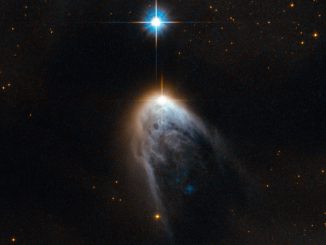
In this NASA/ESA Hubble Space Telescope image, we see a young star breaking out. The golden veil of light cloaks a young stellar object known only as IRAS 14568-6304 in the Circinus molecular cloud complex. This stellar newborn is ejecting gas at supersonic speeds and eventually will have cleared a hole in the cloud, allowing it to be easily visible to the outside universe.
News

Rosetta’s Comet 67P contains ingredients for life

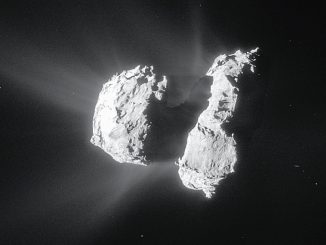
The possibility that water and organic molecules were brought to the early Earth through cometary impacts has long been the subject of important debate. Now, ingredients crucial for the origin of life on Earth, including the simple amino acid glycine and phosphorus — key components of DNA and cell membranes — have been discovered at Comet 67P/Churyumov-Gerasimenko.

Picture This

The giant stars and the little fox

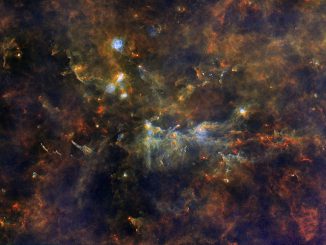
This infrared image from ESA’s Herschel Space Observatory shows the region known as Vulpecula OB1, a ‘stellar association’ in which a batch of truly giant ‘OB’ stars is being born 8,000 light-years away in the constellation of Vulpecula (The Little Fox). There is enough material here to build stars for millions of years to come.

News

2007 OR10: the largest unnamed world in the solar system

By combining data from two space observatories, astronomers have revealed something surprising: a 955-mile-wide dwarf planet named 2007 OR10 is significantly larger than previously thought. Although its 547-year-long elliptical orbit brings it nearly as close to the Sun as Neptune, 2007 OR10 is currently twice as far from the Sun as Pluto.

Uncategorized

How to view the transit of Mercury online on 9 May

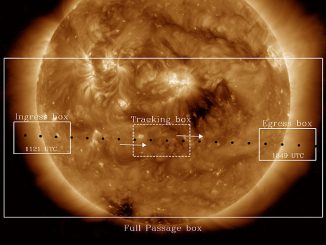
The 2016 transit of Mercury is upon us! With fine weather predicted across a large swathe of the British Isles, many will enjoy clear skies for at least some of this 7½-hour event. But if you don’t have a suitably equipped telescope, or are unable to attend any of the transit-viewing activities organised nationwide, you can still view the phenomenon online.

Uncategorized

Where to view the transit of Mercury on 9 May

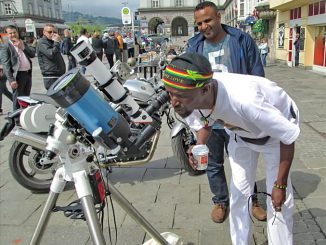
With the transit of Mercury just two days away, interest in this comparatively rare event is growing fast. Given the favourable timing of this 7½-hour phenomenon for the UK, many will be able to view it at lunchtime or after work. If you don’t have suitably equipped telescope, join one of the many transit-viewing activities hosted by astronomical organisations nationwide.

News

Rare transit of Mercury to take place on 9 May

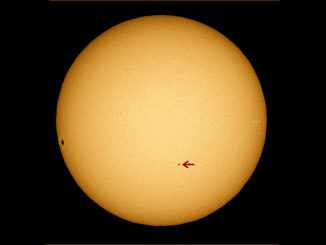
On Monday, 9 May there will be a rare transit of Mercury, when the innermost planet in our solar system will pass directly between the Earth and the Sun. The last time this happened was in 2006. With a properly filtered telescope and fine weather, the entire 7½-hour event can be seen from the British Isles.

Picture This

Herschel’s view of the Eagle Nebula

The Eagle Nebula, also known as Messier 16 (M16), as seen by ESA’s Herschel Space Observatory. A group of young, bright stars, not visible at these infrared wavelengths, are located near the centre of the image. The powerful light emitted by these stars is setting the surrounding gas ablaze, causing it to shine.