
2 May 2026
Astronomy Now
  • Home
  • The Magazine
    • About
    • Current Issue
    • Subscribe
    • Renew Subscription
  • AstroFest 2026
  • News
  • Observing
    • UK Sky Chart
    • Almanac
    • Scope Calc
    • DSLR Calc
  • Reviews
    • Equipment
    • Book Reviews
  • Spaceflight Now
  • Shop
  • Contact Us
    • Subscriptions
    • Your Views
    • Ask Astronomy Now
    • Editorial
    • Advertising
    • AstroListings
Latest News
  • [ 14 April 2026 ] Moon dust preserves record of life’s building blocks News
  • [ 11 April 2026 ] Dark matter may come in multiple forms, new model suggests News
  • [ 2 April 2026 ] Witness to history: Artemis II, lunar exploration and hope News
  • [ 25 March 2026 ] Artificial Intelligence uncovers more than 100 new worlds in NASA data News
  • [ 24 March 2026 ] XRISM solves gamma-Cas’s 50-year X-ray mystery News
  • Facebook
  • Twitter
  • LinkedIn

Betelgeuse

News

Red hypergiant mimics Betelguese with dusty dimming on a vast scale

7 March 2021 Astronomy Now

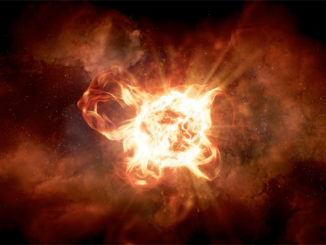
Red hypergiant star mimics Betelgeuse with dust-related dimming, but on a vastly larger scale.

News

Red supergiant Betelgeuse not so bright, not so giant, not so far away

16 October 2020 Astronomy Now

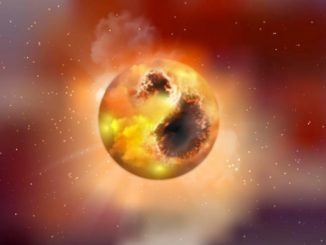
The red supergiant Betelgeuse, a prime supernova candidate in the not-too-distant future, may not be quite as large and far away as previously thought.

News

Hubble offers explanation for dramatic dimming of Betelgeuse

14 August 2020 Astronomy Now

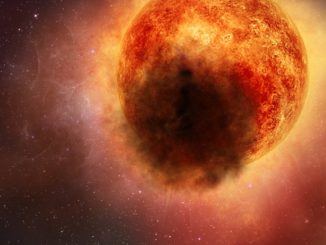
Observations by the Hubble Space Telescope suggest a huge eruption and resulting dust cloud caused recent dimming of Betelgeuse.

News

Giant star spots, not dust, likely culprit in dimming of Betelgeuse

29 June 2020 Astronomy Now

The pronounced dimming of the red giant Betelgeuse likely was caused by huge star spots, not by intervening dust, researchers say.

News

Cosmic dust up may best explain dimming of Betelgeuse

8 March 2020 Astronomy Now

Taking the temperature of Betelgeuse, astronomers say the supergiant’s recent dimming likely caused by thrown-off gas obscuring the view.

News

ESO’s Very Large Telescope shows dramatic dimming of Betelgeuse

14 February 2020 Astronomy Now

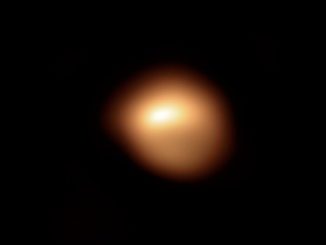
Astronomers capture dramatic before-and-after views of the red supergiant Betelgeuse, showing major changes in brightness and shape.

Observing

Don’t miss the Geminid meteor shower 13–14 December 2018

13 December 2018 Ade Ashford

The December Geminid meteor shower is generally regarded as the richest and most reliable of the major annual shooting star displays. This year the predicted peak occurs close to 12h UT on 14 December, though high rates of activity should be encountered between 8pm GMT on Thursday, 13 December and 5pm GMT the following evening.
Picture This

See the sharpest-ever view of giant Betelgeuse

30 June 2017 Astronomy Now

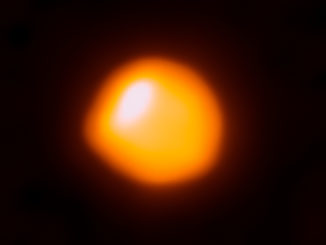
This orange blob shows the nearby star Betelgeuse, as seen by the Atacama Large Millimeter/submillimeter Array. This is the first time that ALMA has ever observed the surface of a star and this first attempt has resulted in the highest-resolution image of Betelgeuse available.

Observing

See planet Venus dazzle at greatest brilliancy in the pre-dawn sky

17 September 2015 Ade Ashford

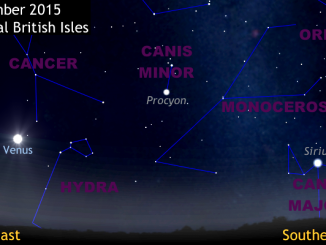
Early risers wishing to see Venus as a dazzling ‘morning star’ need only glance low to the east in the pre-dawn sky. The planet reaches greatest brilliancy on Sunday, 20 September when, for a couple of mornings, it can be seen outshining brightest nighttime star Sirius in the southeast by a factor of seventeen times. Can you see your shadow cast by Venus?

Latest Issue

Astronomy Now Newsletter

Join our mailing list.
* indicates required
Which elements of Astronomy interest you?

News Headlines

  • Moon dust preserves record of life’s building blocks
    14 April 2026
  • Dark matter may come in multiple forms, new model suggests
    11 April 2026
  • Witness to history: Artemis II, lunar exploration and hope
    2 April 2026
  • Artificial Intelligence uncovers more than 100 new worlds in NASA data
    25 March 2026
  • XRISM solves gamma-Cas’s 50-year X-ray mystery
    24 March 2026

© 2026 Nebula Press Ltd

Astronomy Now