Observing
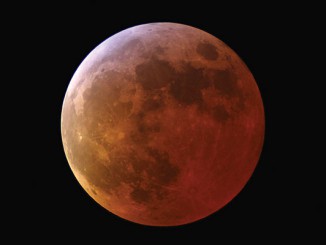
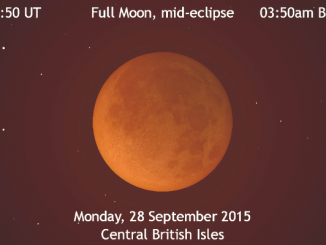
Don’t miss the totally eclipsed ‘supermoon’ of 28 September
While you probably don’t relish the prospect of waking up in the small hours of most Monday mornings, you will want to set your alarm for 2am BST on Monday, 28 September for this month’s showstopper celestial event — a rare total lunar eclipse of an unusually large ‘supermoon’ visible in its entirety (weather permitting) from the British Isles!
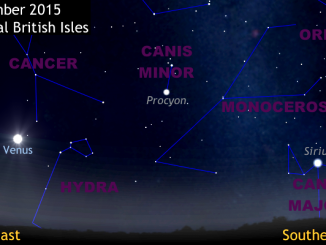
See planet Venus dazzle at greatest brilliancy in the pre-dawn sky
Early risers wishing to see Venus as a dazzling ‘morning star’ need only glance low to the east in the pre-dawn sky. The planet reaches greatest brilliancy on Sunday, 20 September when, for a couple of mornings, it can be seen outshining brightest nighttime star Sirius in the southeast by a factor of seventeen times. Can you see your shadow cast by Venus?
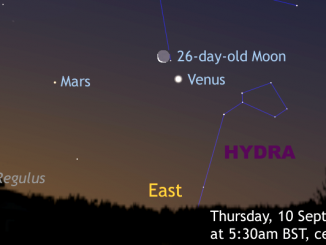
See the Moon & Venus get close in the pre-dawn sky
As dawn creeps across Western Europe on the morning of Thursday, 10 September, a close conjunction of the two brightest objects in the nighttime sky is taking place low in the east an hour before sunrise. So, set your alarm for 5:30am in the UK to see a beautiful juxtaposition of a 26-day-old waning crescent Moon and dazzling planet Venus in the twilight.
See the Moon hit a bull’s-eye in Taurus, pre-dawn 5 September
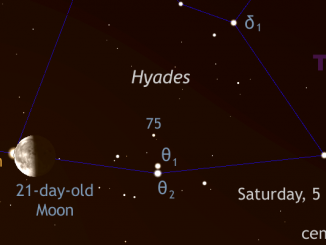
In the dawn twilight of Saturday, 5 September, observers in the British Isles with clear skies can see the last quarter Moon pass in front of first-magnitude star Aldebaran in the constellation Taurus — the brightest star (aside from the Sun) to be occulted by the Moon as seen from the UK this year.
See outermost planet Neptune at its best
When Pluto was reclassified as a dwarf planet in 2006, Neptune regained the title of the solar system’s outermost planet. Since this fascinating gas giant reached opposition on 1 September in the constellation Aquarius, now is a great time to seek it out. We show you how to locate Neptune with binoculars and small telescopes.
See the Moon meet Saturn and a star disappear on 22 August
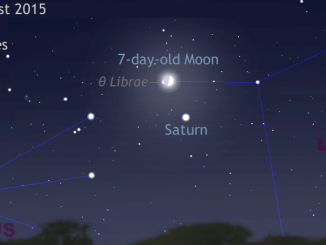
As dusk fades to dark on Saturday, 22 August, observers in the British Isles and Western Europe with clear skies can see the first quarter Moon close above planet Saturn low to the southwest. But for those skywatchers with binoculars and small telescopes, an additional treat is in store as the Moon passes in front of (occults) a naked-eye star.
See the return of the Andromeda Galaxy
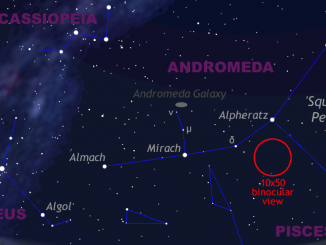
Are you looking for something to whet your observing appetite and celebrate the return of late summer dark skies to the British Isles? Why not welcome back the Andromeda Galaxy to the Northern Hemisphere night sky in this observing guide to one of the annual harbingers of autumnal celestial delights.
Perseid meteors set to light up 12-13 August skies
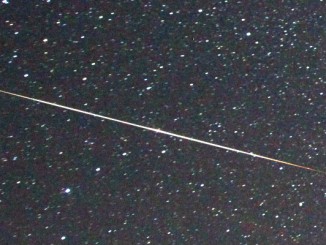
From the evening of Wednesday, 12 August into the early hours of the following morning, it is the maximum of the annual Perseid meteor shower. This year, a new Moon makes prospects for watching this natural firework display particularly good. So, find somewhere away from the streetlights, settle into a garden lounger facing northeast, and enjoy the show!