News
TRAPPIST-1 is older than our Solar System
Scientists now have a good estimate for the age of one of the most intriguing planetary systems discovered to date — TRAPPIST-1, a system of seven Earth-size worlds orbiting an ultra-cool dwarf star about 40 light-years away. Researchers say in a new study that the TRAPPIST-1 star is quite old: between 5.4 and 9.8 billion years. This is up to twice as old as our own Solar System, which formed some 4.5 billion years ago.
Station-bound instrument to open new chapter in the story of cosmic rays
Physicists are gearing up to send a re-engineered science instrument originally designed for lofty balloon flights high in Earth’s atmosphere to the International Space Station next week to broaden their knowledge of cosmic rays, subatomic particles traveling on intergalactic routes that could hold the key to unlocking mysteries about supernovas, black holes, pulsars and dark matter.
New Horizons’ next target might be a binary pair
Ground observations of the New Horizons spacecraft’s next target last month revealed the distant object, lurking in the outer Solar System more than four billion miles from Earth, might have an unconventional elongated shape, or even consist of two icy bodies orbiting one another in an age-old cosmic dance.
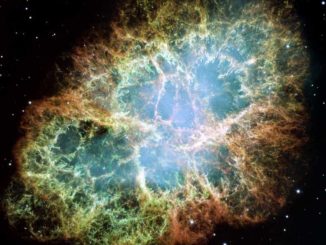
Astronomers discover ‘heavy metal’ supernova rocking out
Many rock stars don’t like to play by the rules, and a cosmic one is no exception. A team of astronomers has discovered that an extraordinarily bright supernova occurred in a surprising location. This “heavy metal” supernova discovery challenges current ideas of how and where such super-charged supernovas occur.