30 July 2026
Astronomy Now
  • Home
  • The Magazine
    • About
    • Current Issue
    • Subscribe
    • Renew Subscription
  • AstroFest 2026
  • News
  • Observing
    • UK Sky Chart
    • Almanac
    • Scope Calc
    • DSLR Calc
  • Reviews
    • Equipment
    • Book Reviews
  • Spaceflight Now
  • Shop
  • Contact Us
    • Subscriptions
    • Your Views
    • Ask Astronomy Now
    • Editorial
    • Advertising
    • AstroListings
Latest News
  • [ 25 July 2026 ] Euclid opens a new window on the first billion years of cosmic history News
  • [ 10 June 2026 ] Caught in the act: the wind that could kill a galaxy News
  • [ 4 June 2026 ] Europe’s Mars rover may land in the remains of a vast ancient water system News
  • [ 14 April 2026 ] Moon dust preserves record of life’s building blocks News
  • [ 11 April 2026 ] Dark matter may come in multiple forms, new model suggests News
  • Facebook
  • Twitter
  • LinkedIn

News

News

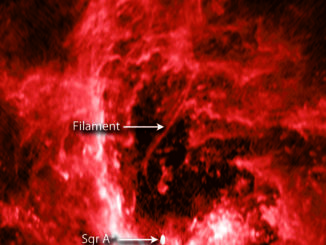
Cosmic filament probes our galaxy’s giant black hole

21 December 2017 Astronomy Now

The centre of our galaxy has been intensely studied for many years, but it still harbors surprises for scientists. A snake-like structure lurking near our galaxy’s supermassive black hole is the latest discovery to tantalise astronomers.

News

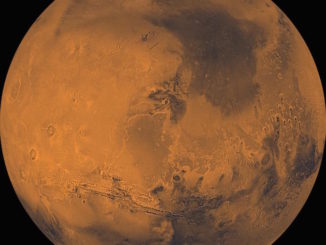
Mars and Earth may not have always been neighbours

21 December 2017 Astronomy Now

A study published in the journal Earth and Planetary Science Letters posits that Mars formed in what today is the Asteroid Belt, roughly one and a half times as far from the Sun as its current position, before migrating to its present location.

News

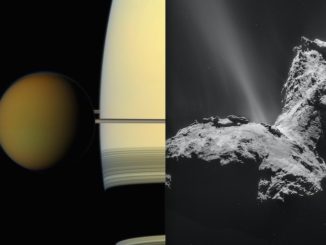
Titan drone, comet sampler picked as finalists for NASA mission

20 December 2017 Stephen Clark

NASA has narrowed its choices for a new billion-dollar robotic space mission: A nuclear-powered quadcopter to explore the hazy landscape of Saturn’s largest moon Titan, or a probe to scoop up a piece of a comet and return it to Earth.

News

Artificial intelligence, NASA data used to discover eighth planet circling distant star

17 December 2017 Astronomy Now

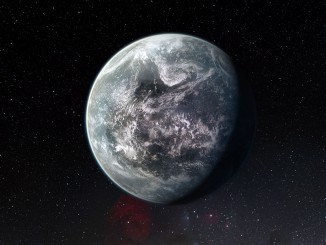
Our solar system now is tied for most number of planets around a single star, with the recent discovery of an eighth planet circling Kepler-90, a Sun-like star 2,545 light-years from Earth. The planet was discovered in data from NASA’s Kepler Space Telescope.

News

Meteorite’s origins point to possible undiscovered asteroid

11 December 2017 Astronomy Now

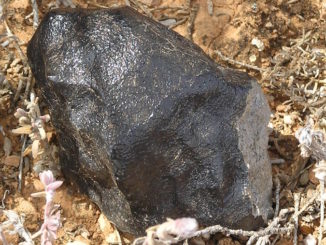
A new analysis of a meteorite called Bunburra Rockhole has revealed that the rock originated from a previously unknown parent asteroid, allowing scientists to understand the geology of the parent body.

News

Hydrothermal vent experiments bring Enceladus to Earth

11 December 2017 Astronomy Now

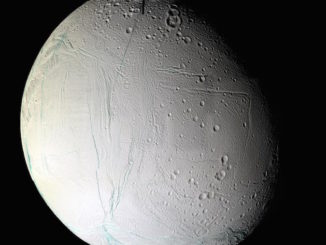
Laboratory experiments on Earth can now simulate the conditions under which life might emerge on Saturn’s moon Enceladus, as well as other icy alien worlds, according to new research published in journal Astrobiology.

News

Found: The most distant supermassive black hole ever observed

6 December 2017 Astronomy Now

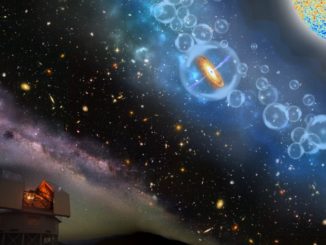
A team of astronomers have discovered the most-distant supermassive black hole ever observed. It resides in a luminous quasar and its light reaches us from when the Universe was only 5 percent of its current age — just 690 million years after the Big Bang.

News

First light achieved for next-generation planet-hunter

6 December 2017 Astronomy Now

A new planet-seeking instrument installed on the European Southern Observatory’s Very Large Telescope in Chile has made its first observations, beginning a search for exoplanets with unprecedented precision by looking at the minuscule changes in the light of their host stars.

News

Jupiter’s moons, black holes, exoplanets among JWST’s first scientific targets

4 December 2017 Stephen Clark

The James Webb Space Telescope should start returning its first scientific results by the end of 2019, and scientists recently announced a slate of observations selected to whet the appetites of astronomers who will use the multibillion-dollar facility well into the 2020s.

News

Voyager 1 probe fires long-dormant thrusters in interstellar space

3 December 2017 Stephen Clark

NASA’s Voyager 1 spacecraft has fired a set of four control thrusters for the first time in 37 years, giving the long-lived probe a new way to point itself on its cruise into interstellar space 13 billion miles from Earth.

Posts pagination

« 1 … 84 85 86 … 219 »

Latest Issue

Astronomy Now Newsletter

Get the wonders of the Universe delivered to your inbox.
* indicates required
Which elements of Astronomy interest you?

News Headlines

  • Euclid opens a new window on the first billion years of cosmic history
    25 July 2026
  • Caught in the act: the wind that could kill a galaxy
    10 June 2026
  • Europe’s Mars rover may land in the remains of a vast ancient water system
    4 June 2026
  • Moon dust preserves record of life’s building blocks
    14 April 2026
  • Dark matter may come in multiple forms, new model suggests
    11 April 2026

© 2026 Nebula Press Ltd

Astronomy Now