News

Moons of Saturn may be younger than the dinosaurs

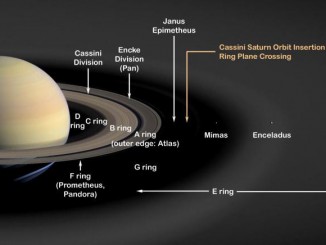
New research suggests that some of Saturn’s icy moons, as well as its famous rings, might be modern adornments. Their dramatic birth may have taken place a mere 100 million years ago. This would date the formation of the major moons of Saturn, with the exception of more distant Titan and Iapetus, to the relatively recent Cretaceous Period — the era of the dinosaurs.

News

Cassini spies Titan’s tallest peaks

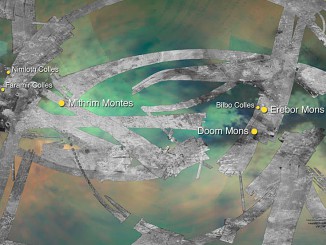
By convention, mountains on Saturn’s largest moon, Titan, are named for mountains from Middle-earth, the fictional setting in fantasy novels by J.R.R. Tolkien. Unfortunately for “Lord of the Rings” fans, Titan’s highest peak is not Doom Mons, but a trio of ridges known as Mithrim Montes, where the tallest peak is 10,948 feet (3,337 metres) high.

News

A new way to determine the age of stars?

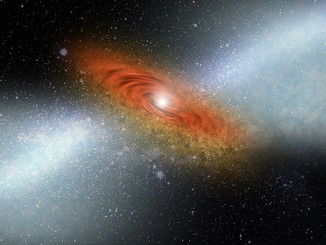
Researchers have developed a new conceptual framework for understanding how stars similar to our Sun evolve. Their framework helps explain how the rotation of stars, their emission of X-rays, and the intensity of their stellar winds vary with time. Their work could ultimately help to determine the age of stars more precisely than is currently possible.

News

Ancient lunar polar ice reveals tilting of Moon’s axis

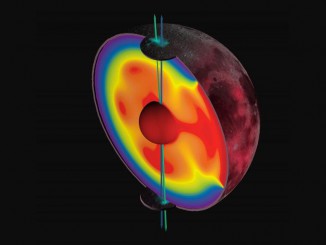
Did the “Man in the Moon” look different from ancient Earth? New NASA-funded research provides evidence that the spin axis of the Moon shifted by about five degrees roughly three billion years ago. The evidence of this motion is recorded in the distribution of ancient lunar ice, evidence of delivery of water to the early solar system.

News

Solar storms ignite X-ray aurorae on Jupiter

Solar storms are triggering X-ray aurorae on Jupiter that are about eight times brighter than normal over a large area of the planet and hundreds of times more energetic than Earth’s “northern lights,” according to a new study using data from NASA’s Chandra X-ray Observatory when a giant solar storm arrived at the planet.

News

Ancient dwarf galaxy preserves record of catastrophic event

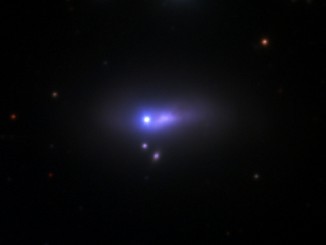
The lightest few chemical elements formed minutes after the Big Bang. Most heavier elements in the periodic table are created by stars, either from internal nuclear fusion or in catastrophic explosions. New observations of a dwarf galaxy discovered last year show that the heaviest elements, such as gold and lead, are likely left over from rare collisions between two neutron stars.