
News


The central supermassive black hole of a recently discovered galaxy called SAGE0536AGN is far larger than should be possible, according to current theories of galactic evolution. The galaxy was found by accident with NASA’s Spitzer space telescope and is thought to be at least 9 billion years old. Time will tell whether SAGE0536AGN really is an oddball, or simply the first in a new class of galaxies.

This new image of the rose-coloured star forming region Messier 17 was captured by the Wide Field Imager on the MPG/ESO 2.2-metre telescope at ESO’s La Silla Observatory in Chile. It is one of the sharpest images showing the entire nebula and not only reveals its full size, but also retains fine detail throughout the cosmic landscape of gas clouds, dust and newborn stars.

This image was captured from Sunset Peak, Lantau Island, Hong Kong by astrophotographer Chap Him Wong. Above the peak covered with gold and silver grass, the tantalising sky reveals star trails and the Milky Way beyond — winning image of the People & Space category in the Insight Astronomy Photographer of the Year competition 2015.
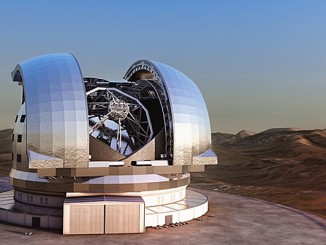
UK researchers have just signed an agreement to lead one of the first instruments for what will become the World’s largest visible and infrared telescope, the European Extremely Large Telescope (E-ELT). The spectrograph, called HARMONI, will provide the European Southern Observatory’s telescope with a sensitivity that is up to hundreds of times better than any current telescope of its kind.

Omega (ω) Centauri, or NGC 5139, is the brightest and largest globular cluster. This showpiece object of the southern sky is captured here in all its glory by astrophotographer Ignacio Diaz Bobillo — winning image of the Stars & Nebulae category in the Insight Astronomy Photographer of the Year competition 2015.
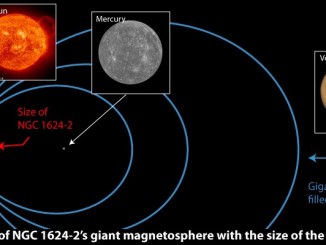
O-type stars are the hottest and brightest stars known. NASA’s Chandra X-ray Observatory has revealed that the magnetic field at the surface of NGC 1624-2 is 20,000 times stronger than at the surface of our Sun. NGC 1624-2 contains a raging storm of extreme stellar winds and dense plasma that gobbles up X-rays before they can escape into space.
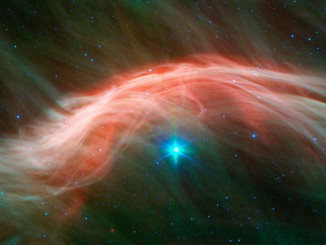
The centre of our Milky Way galaxy is a mysterious place. Not only is it thousands of light-years away, it’s also cloaked in so much dust that most stars within are rendered invisible. Harvard researchers are proposing a new way to clear the fog and spot stars hiding there. They suggest looking for radio waves coming from supersonic stars.
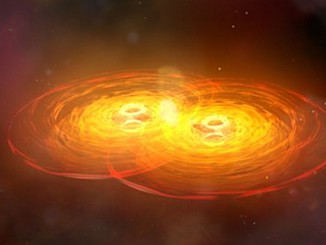
There may be fewer pairs of supermassive black holes orbiting each other at the cores of giant galaxies than previously thought, according to a new study. When two massive galaxies harbouring supermassive black holes collide, their black holes ultimately combine — a process that could be the strongest source of elusive gravitational waves, still yet to be directly detected.

© 2019 Pole Star Publications Limited