News

Banking X-ray data for the future

NASA’s Chandra X-ray Observatory has collected data for over sixteen years on thousands of different objects throughout the universe. Once the data is processed, all of the data goes into an archive and is available to the public. To celebrate American Archive Month, a collection of new images from the Chandra archive has just been released.
Picture This

Hubble sees an ageing star wave goodbye

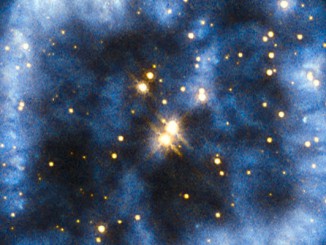
When stars that are around the mass of the Sun reach their final stages of life, they shed their outer layers into space, which appear as glowing clouds of gas called planetary nebulae. In the case of Menzel 2, otherwise known as PK 329-02.2, the nebula forms a winding blue cloud that perfectly aligns with two stars at its centre.

News

Understanding pulsating aurorae

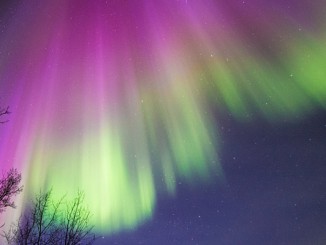
Thanks to a lucky conjunction of two satellites, a ground-based array of all-sky cameras, and some spectacular aurorae boreales, researchers have uncovered evidence for an unexpected role that electrons have in creating the dancing aurorae. Though humans have been seeing aurorae for thousands of years, we have only recently begun to understand what causes them.

News

Exoplanet anniversary: from zero to thousands in 20 years

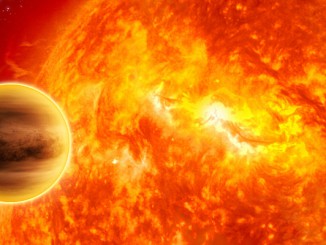
On 6 October 1995, astronomers started a revolution with the discovery of 51 Pegasi b — the first planet found orbiting a Sun-like star beyond our solar system. As we celebrate the 20th anniversary of that momentous discovery, the current total of known exoplanets stands at 5,596. More than 1,000 of these were discovered by NASA’s Kepler mission.

Picture This

“Comet C/2013 A1 alongside Mars” by Sebastian Voltmer

This image is the last winner we have from the eleven categories in the Insight Astronomy Photographer of the Year competition 2015 — that of using a robotic telescope. It shows the power of remote imaging, since Sebastian Voltmer in Germany used the iTelescope at Siding Spring Observatory in Australia to capture Comet C/2013 A1 passing very close to Mars on 19 October 2014.

News

Peeking into our galaxy’s stellar nursery

Astronomers have long turned their telescopes to the wide swaths of interstellar medium to get a look at the formation and birth of stars. A team of international researchers has just released the most comprehensive images anyone has ever seen of the Milky Way’s cold interstellar gas clouds where new stars and solar systems are being born.

News

Researchers find a new way to weigh pulsars

Until now, scientists have determined the mass of stars, planets and moons by studying their motion in relation to others nearby, using the gravitational pull between the two as the basis for their calculations. However, in the case of young pulsars, mathematicians at the University of Southampton have now found a new way to measure their mass — even if a star exists on its own in space.