News

Astronomers catch a black hole shredding a star to pieces

When a star comes too close to the intense gravity of black hole, the resulting tidal forces can rip the star apart. In these so-called tidal disruptions, some of the stellar debris is flung outward at high speeds, while the rest falls toward the black hole, causing a distinct X-ray flare that can last for years. A team of astronomers has observed a tidal disruption event in galaxy PGC 043234 that lies about 290 million light-years from Earth.

News

White dwarf “Death Star” seen destroying a planet

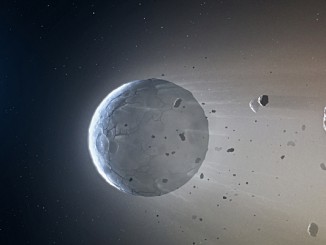
The Death Star of the movie Star Wars may be fictional, but planetary destruction is real. Astronomers announced today that they have spotted a large, rocky object disintegrating in its death spiral around a distant white dwarf star. The discovery also confirms a long-standing theory behind the source of white dwarf “pollution” by metals.

News

Final kiss of two stars heading for catastrophe

Using ESO’s Very Large Telescope, an international team of astronomers have found the hottest and most massive double star with components so close that they touch each other. The two stars in the extreme system VFTS 352 could be heading for a dramatic end, during which the two stars either coalesce to create a single giant star, or form a binary black hole.

Observing

See the Orionid meteor shower peak 21-23 October

The highlight of October for meteor observers is the Orionid meteor shower, which occurs when the Earth encounters the debris stream of Halley’s Comet. With a broad maximum 21-23 October, peak rates are typically about a quarter of those seen for the Perseids of August. A good percentage of Orionids are bright and leave persistent trains.

News

Theoretical study concludes most Earth-like worlds have yet to be born

Earth came early to the party in the evolving universe. According to a new theoretical study, when our solar system was born 4.6 billion years ago only eight percent of the potentially habitable planets that will ever form in the universe existed. And, the party won’t be over when the Sun burns out in another 6 billion years. The bulk of those planets — 92 percent — have yet to be born.

News

The minimum mass of a proto-solar system disc

Astronomers studying the birth of planetary systems in the young (about 2-3 million years old) star forming region IC348 in Perseus as seen by the infrared cameras onboard the Spitzer Space Telescope have found thirteen stars in this complex with detectable discs, none of which is as massive as our early solar system’s disc.