News

New details on Ceres seen in Dawn images

Features on dwarf planet Ceres that piqued the interest of scientists throughout 2015 stand out in exquisite detail in the latest images from NASA’s Dawn spacecraft, which recently reached its lowest-ever altitude at Ceres. Dawn took these images near its current altitude of 240 miles (385 kilometers) between 19 and 23 December 2015.

Observing

See Comet Catalina pass overhead from UK when closest to Earth

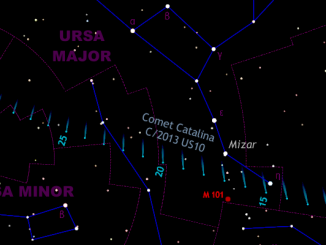
Having brushed by bright star Arcturus on 1 January, Comet Catalina (C/2013 US10) continues its trek through the constellations of the far north. Now a circumpolar object for the British Isles, in the early hours of 17 January it lies between famous double star Mizar (ζ Ursae Majoris) and the Pinwheel Galaxy (M101), virtually overhead in the UK.

News

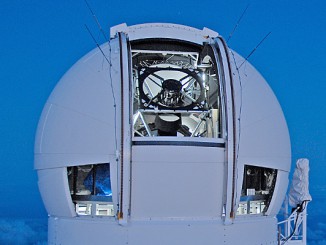
NASA office to coordinate asteroid detection and hazard mitigation

NASA has formalised its ongoing program for detecting and tracking near-Earth objects (NEOs) as the Planetary Defense Coordination Office (PDCO). The office will be responsible for supervision of all NASA-funded projects to find and characterise asteroids and comets that pass near Earth. It will also take a leading role in coordinating efforts in response to any potential impact threats.

News

Proof that some galaxies are LIERs

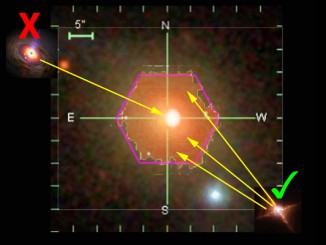
You might think that astronomers could easily tell the difference between a black hole and a white dwarf — but nature can be deceptive. Astronomers from the Sloan Digital Sky Survey (SDSS) have just announced the results of a new study that reveals the true origin of puzzling light from nearby galaxies.

Picture This

Martian starburst spiders

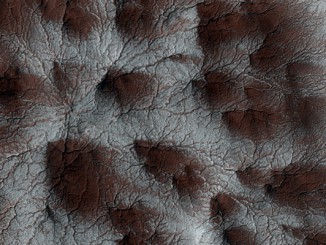
Mars’ seasonal cap of carbon dioxide ice has eroded many beautiful terrains as it sublimates (goes directly from ice to vapour) every spring. In the region where the High Resolution Imaging Science Experiment (HiRISE) camera on NASA’s Mars Reconnaissance Orbiter took this image, we see troughs that form a starburst pattern.

Picture This

A galactic mega-merger

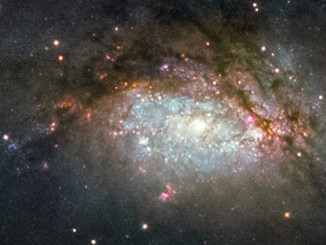
The subject of this NASA/ESA Hubble Space Telescope image is known as NGC 3597. It is the product of a collision between two good-sized galaxies, and is slowly evolving to become a giant elliptical galaxy. This type of galaxy has grown more and more common as the universe has evolved, with initially small galaxies merging and progressively building up into larger galactic structures over time.

Picture This

‘X’ marks a curious corner on Pluto’s icy plains

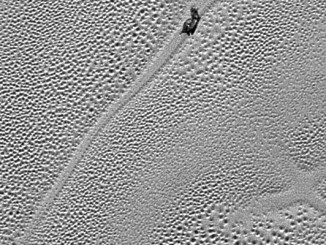
“X” marks the spot of some intriguing surface activity in the latest picture of Pluto returned from NASA’s New Horizons spacecraft. This image from the Long Range Reconnaissance Imager (LORRI) extends New Horizons’ highest-resolution views of Pluto to the very centre of Sputnik Planum, the informally named icy plain that forms the left side of Pluto’s “heart” feature.

News

The case of the missing quasar

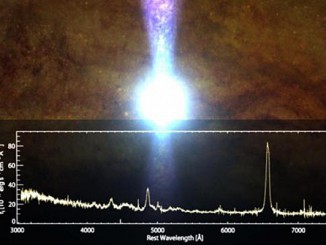
Astronomers can’t find any sign of the black hole at the centre of the quasar SDSS J1011+5442, and they couldn’t be happier. The black hole is still there, of course, but over the past ten years, it appears to have swallowed all the gas in its vicinity. With the gas consumed, researchers were unable to detect the spectroscopic signature of the quasar, which now appears as an otherwise normal galaxy.