News

Noodle-shaped plasma lenses may lurk in the Milky Way

According to a team of astronomers led by Dr. Keith Bannister of CSIRO Astronomy and Space Science Division in Australia, invisible noodle- or shell-shaped plasma structures could be floating around in the Milky Way. These structures, which focus and defocus radio waves from distant sources such as quasars, could radically change our ideas about the Galaxy’s interstellar gas.

News

Are aliens silent because they are all extinct?

Life on other planets would likely be brief and become extinct very quickly, say astrobiologists from The Australian National University (ANU). In research aiming to understand how life might develop, the scientists realised new life would commonly die out due to runaway heating or cooling on their fledgling planets.

Picture This

Hubble captures star cluster’s dazzling diamonds

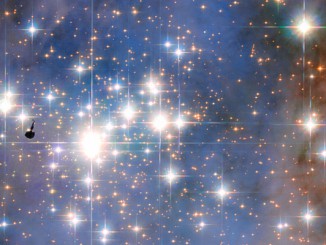
Some of the Milky Way’s “celebrity stars” — opulent, attention-getting, and short-lived — can be found in this Hubble Space Telescope image of the glittering star cluster called Trumpler 14. It is only 500,000 years old, has one of the highest concentrations of massive, luminous stars in the entire Galaxy and is located 8,000 light-years away in the Carina Nebula.

Observing

See all five naked-eye planets gathered in the morning sky

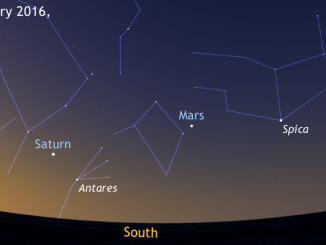
All five of the bright naked-eye planets are observable in the pre-dawn sky from about the third week of January 2016, particularly if one lives south of the equator. But even from the UK, you can get to view the spectacle if you time it right — and the weather obliges! The last time that Mercury, Venus, Mars, Jupiter and Saturn appeared in the same sky was 11 years ago.

News

NASA’s Van Allen probes revolutionise view of radiation belts

About 600 miles from Earth’s surface is the first of two doughnut-shaped electron swarms, known as the Van Allen Belts. Understanding the shape and size of the belts, which can shrink and swell in response to incoming radiation from the Sun, is crucial for protecting technology in space. A new study of data from NASA’s Van Allen Probes reveals that the story is a complex one.

Picture This

Saturn’s moons Janus and Tethys

Janus and Tethys demonstrate the main difference between small moons and large ones; it’s all about their shape. Moons like Tethys are large enough that their own gravity is sufficient to overcome the material strength of the substances they are made of and mould them into spherical shapes, but small moons like Janus are not massive enough for their gravity to form them into a sphere.

News

A Milky Way twin swept by an ultrafast X-ray wind

ESA’s XMM-Newton X-ray space observatory has found a wind of high-speed gas streaming from the centre of a bright spiral galaxy like our own that may be reducing its ability to produce new stars. The Seyfert galaxy, known as IRAS17020+4544 and located 800 million light-years from Earth, has a supermassive black hole at its core with a mass of nearly six million Suns.