X-Highlight
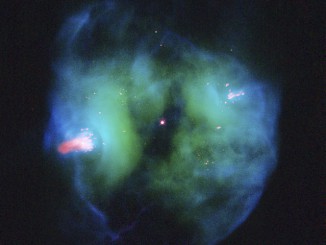
Astronomers discover white dwarf with an oxygen atmosphere
Researchers have discovered a white dwarf star with an atmosphere dominated by oxygen — a type of white dwarf that has been theorised to exist but not identified to date. The finding could challenge the textbook wisdom of single stellar evolution, and provide a critical link to some types of supernovae discovered over the past decade.
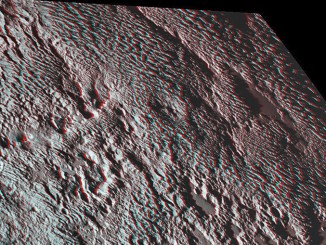
View Pluto’s bladed terrain in 3-D
One of the strangest landforms spotted by NASA’s New Horizons spacecraft when it flew past Pluto was the “bladed” terrain formally named Tartarus Dorsa. The blades reach hundreds of feet high and are typically spaced a few miles apart. No geology degree is necessary to see why the terrain is so interesting — just grab your red and green 3-D spectacles.
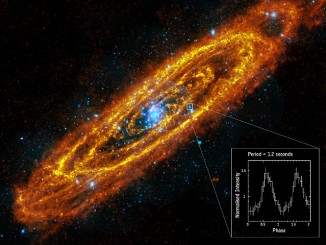
Andromeda Galaxy’s first spinning neutron star found
Decades of searching in the Andromeda Galaxy has finally paid off, with the discovery of an elusive breed of stellar corpse — a neutron star, by ESA’s XMM-Newton space telescope. Neutron stars are the small and extraordinarily dense remains of a once-massive star that exploded as a powerful supernova at the end of its natural life.
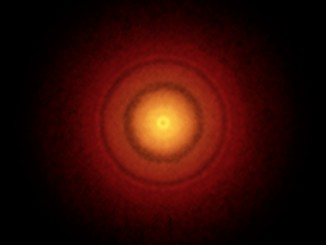
A planet is forming in an Earth-like orbit around a young star
Discs of dust and gas that surround young stars are the formation sites of planets. New images from the Atacama Large Millimetre/submillimetre Array (ALMA) reveal never-before-seen details in the planet-forming disc around a nearby Sun-like star, including a tantalising gap at the same distance from the star as the Earth is from the Sun.
Jupiter continues to delight and amaze observers during April
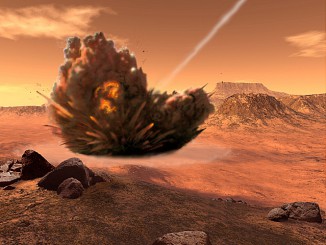
The impact of a small comet or asteroid on Jupiter observed by European amateur astronomers on 17 March has heightened interest in the solar system’s largest planet. While such an event is uncommon, Jupiter and its family of four bright Galilean moons provide a wealth of other interesting phenomena to view with small telescopes during April.
Map of rocky exoplanet reveals a lava world
An international team of astronomers, led by the University of Cambridge, has obtained the most detailed ‘fingerprint’ of a rocky planet outside our solar system to date, and found a planet of two halves: one that is almost completely molten, and the other which is almost completely solid. Exoplanet 55 Cancri e lies 40 light-years from the Sun.
Trigger for Milky Way’s youngest supernova identified
Astronomers have used data from NASA’s Chandra X-ray Observatory and the VLA to determine the likely trigger for the most recent supernova in the Milky Way. They applied a new technique that could have implications for understanding other Type Ia supernovae, a class of stellar explosions that scientists use to determine the expansion rate of the universe.
Earth-space telescope observations of quasar 3C 273’s hot heart
Astronomers using an orbiting radio telescope in conjunction with four ground-based radio telescopes have achieved the highest resolution, or ability to discern fine detail, of any astronomical observation ever made. The researchers were surprised when their Earth-space system revealed a core temperature hotter than 10 trillion degrees for quasar 3C 273.