News

Asteroid 2013 TX68 won’t hit Earth, but will get close

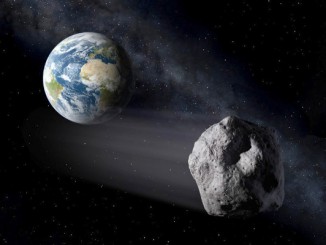
Discovered by the Catalina Sky Survey on 6 October 2013 a week before its last close flyby of Earth, 30-metre-wide asteroid 2013 TX68 was initially thought to pass by Earth again on 5 March 2016. Additional observations of the body have now been obtained, refining its orbital path and moving the date of the asteroid’s close brush with our planet to 8 March.
Picture This

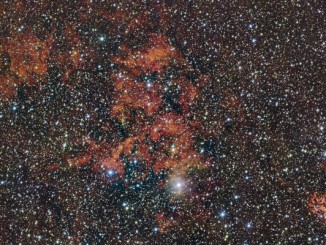
The realm of buried giants

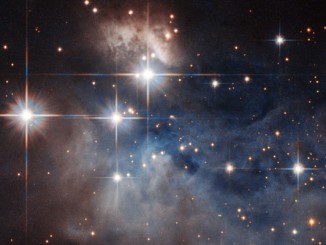
In this huge image of part of the southern constellation of Norma, wisps of crimson gas are illuminated by rare, massive stars that have only recently ignited and are still buried deep in thick dust clouds. The vast nebula where these giants were born, known as RCW 106, is captured here in fine detail by ESO’s VLT Survey Telescope (VST), at the Paranal Observatory in Chile.

News

Why celestial bodies come in different sizes

Since the 1700s scientists have known that gravity causes objects in the universe to get bigger, but the phenomenon of growth does not explain the hierarchy. Now researchers have proposed a new explanation for the size diversity: a universe that contains some big objects and many small objects relieves gravitational tension faster than a uniform universe.

News

Solving the mystery of how Mars’ moon Phobos formed

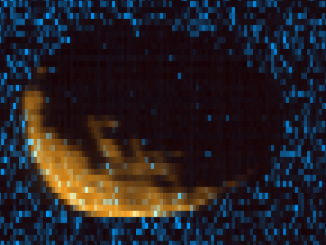
In late November and early December 2015, NASA’s Mars Atmosphere and Volatile Evolution (MAVEN) mission made a series of close approaches to the Martian moon Phobos. Among the data returned were spectral images of Phobos in the ultraviolet. The images will allow MAVEN scientists to better assess the composition of this enigmatic object, whose origin is unknown.

News

Unravelling the Milky Way’s Central Molecular Zone

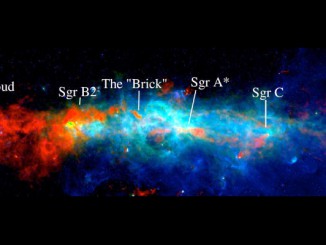
Surrounding the black hole at the centre of our Milky Way galaxy and stretching out to about 700 light-years, is a dense zone of activity called the Central Molecular Zone (CMZ). It contains many dense molecular clouds that would normally be expected to produce new stars, but which are instead eerily desolate. Where did the CMZ come from? No place else in the Milky Way is remotely like it.

News

Supermassive black holes banish matter into cosmic voids

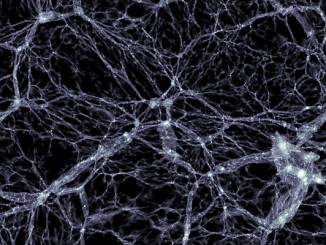
On the largest scales, galaxies and everything they contain are concentrated into filaments that stretch around the edge of enormous voids. Data from the Illustris project, a large computer simulation of the evolution and formation of galaxies, suggests that the black holes at the centre of every galaxy are helping to send matter into the loneliest places in the universe.

Picture This

The frozen canyons of Pluto’s north pole

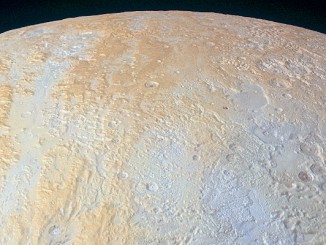
This ethereal scene captured by NASA’s New Horizons spacecraft tells yet another story of Pluto’s diversity of geological and compositional features — this time in an enhanced colour image of the north polar area. A canyon about 45 miles wide runs close to the north pole, its degraded walls suggesting evidence for an ancient period of tectonics.