News

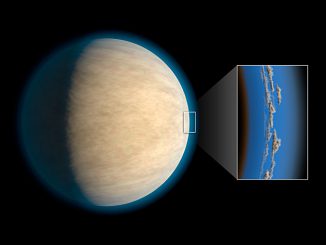
Cloudy days on exoplanets may hide atmospheric water

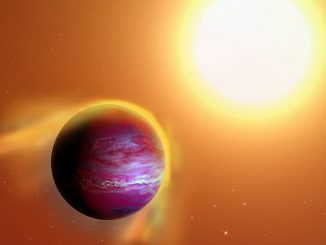
Water is a hot topic in the study of exoplanets, including “hot Jupiters” close to their parent stars that can reach a scorching 1,100 °C, meaning any water they host would take the form of vapour. Hot Jupiters have been found with water in their atmospheres, but others appear to have none. NASA scientists wanted to find out what the atmospheres of these giant worlds have in common.

Uncategorized

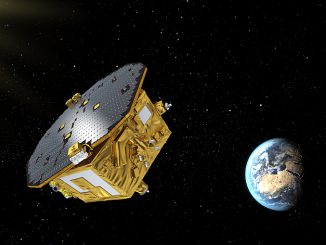
LISA Pathfinder success paves way for space-based gravitational wave detection

LISA Pathfinder, a mission led by the European Space Agency with contributions from NASA, has successfully tested key technology needed to build a space-based observatory for detecting gravitational waves. These tiny ripples in the fabric of space, predicted by Albert Einstein a century ago, were first seen last year by the ground-based Laser Interferometer Gravitational-Wave Observatory (LIGO).

News

Universe’s first life might have been born on carbon planets

Our Earth consists of silicate rocks and an iron core with a thin veneer of water and life, but the first potentially habitable worlds to form might have been very different. New research suggests that the early universe might have contained carbon planets consisting of graphite, carbides, and diamond. Astronomers might find these diamond worlds by searching a rare class of stars.

News

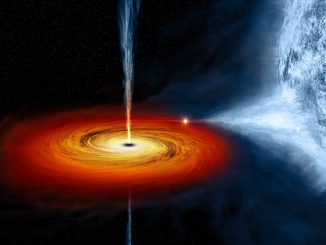
New algorithm could construct first images of black holes

Researchers from MIT and Harvard University have developed a new algorithm that could help astronomers produce the first image of a black hole. The algorithm would stitch together data collected from radio telescopes scattered around the globe in an international collaboration called the Event Horizon Telescope. The project seeks, essentially, to turn the entire planet into a large radio telescope dish.

News

Astronomers measure and model a blazing gamma-ray source

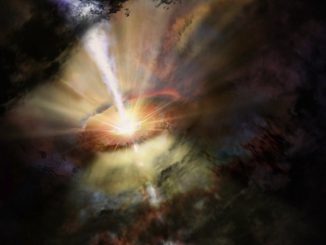
A blazar is a galaxy whose central supermassive black hole emits a powerful jet of high velocity particles aimed almost directly at Earth. Astronomers have measured and successfully modelled the very high energy gamma ray emission from a blazar known as 1ES 1741+196 using VERITAS, the Very Energetic Radiation Imaging Telescope Array System.