News

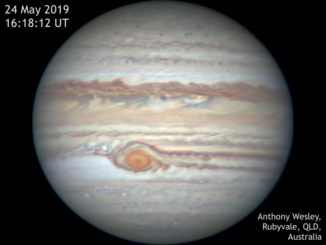
The Great Red Spot (GRS) is the solar system’s largest known storm, an Earth-sized anticyclone that has raged in the atmosphere of Jupiter for at least two centuries. But recent observations from Earth and space suggest that this iconic Jovian feature is undergoing huge changes that could herald its demise.
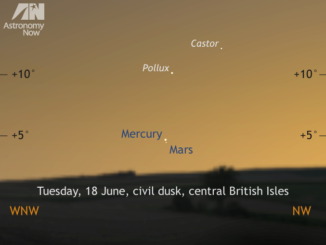
On 18 June at the end of civil twilight in the UK, planets Mars and Mercury lie slightly less than one-quarter of a degree apart in the constellation of Gemini. Observing this conjunction will be a challenge from the UK as the pair will be just 5 degrees high in the west-northwest at civil dusk in bright twilight, which is about 50 minutes after sunset for London.


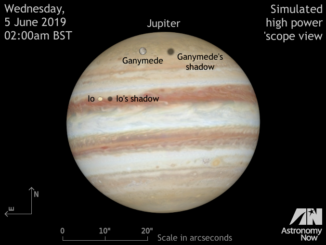
Jupiter, the solar system’s largest planet, reaches opposition on 10 June in the constellation of Ophiuchus (the Serpent Bearer) and is visible low in the southern sky of the UK through the night. Observers with small to medium aperture telescopes can see a number of shadow transits of Jupiter’s Galilean moons and view the planet’s Great Red Spot throughout June.
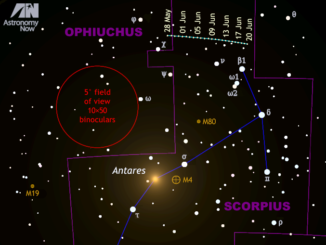
Have you ever seen a dwarf planet? Of the five within our solar system recognised by the International Astronomical Union – Ceres, Pluto, Haumea, Makemake and Eris – only Ceres can be considered bright and easy to locate. It reaches opposition in the constellation of Scorpius on 29 May at magnitude +7, an easy binocular object if you follow our guide.
© 2026 Nebula Press Ltd