Observing

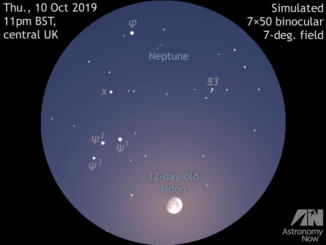
See the waxing Moon meet the outermost planet on 10 October

The 12-day-old Moon lies in the same low-power binocular field as Neptune late into the evening of Thursday, 10 October 2019 when observers in the UK can find the pair highest in the southern sky against the constellation of Aquarius. The glare of the gibbous Moon will present a challenge, but well worth the attempt to find the outermost planet with modest optical aid.
Observing

See the young Moon meet the gas giants at dusk, 3–5 October

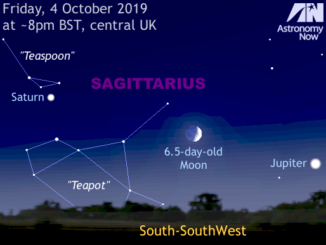
Skywatchers in Western Europe and the UK should look low to the south-southwest at nautical dusk on 3 and 5 October 2019 to view the waxing Moon pass close to Jupiter and Saturn, the Solar System’s largest gas giant planets. Observers at northern temperate latitudes should make the most of any opportunities to view these planets before they are lost in twilight.

Picture This

The Watcher

This breathtaking image of the Northern Lights over Norway’s Lofoten Islands taken by Nicolai Brügger has won the top prize in the aurorae category of the Insight Investment Astronomy Photographer of the Year 2019 competition.

Observing

View the International Space Station at its best from the UK

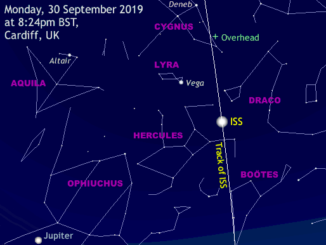
If you have never seen the International Space Station (ISS), make the most of clear skies over the next few nights. It’s capable of exceeding Venus at its brightest and visible for up to 7 minutes as it crawls across the sky in an arc from west to east. Find out when and where to see some favourable passes of this 420-tonne, 109-metre-wide spacecraft over the British Isles and Western Europe.