Picture This

“Full Moon over the Alps” by Stefano De Rosa

Our fourteenth nomination from the prestigious Insight Astronomy Photographer of the Year competition, an annual celebration of the most beautiful and spectacular visions of the cosmos by astrophotographers worldwide. The 2015 competition received 2700 spectacular entries from over 60 countries and the winners will be announced 17 September.

Picture This

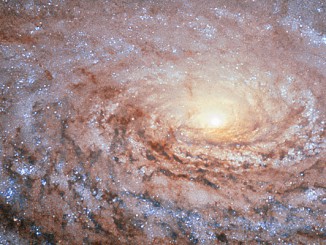
Hubble sees a galactic sunflower

Galactic arms, sunflowers and whirlpools are only a few examples of nature’s apparent preference for spirals. A beautiful example is Messier 63, nicknamed the Sunflower Galaxy, its winding arms shining bright due to the presence of recently formed, blue–white giant stars and clusters, readily seen in this NASA/ESA Hubble Space Telescope image.

News

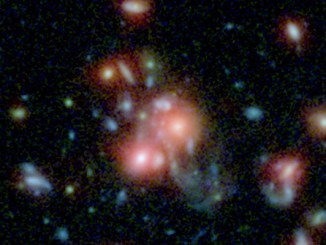
Extreme starburst in the core of a gargantuan galaxy cluster

An international team of astronomers has discovered a prodigious galaxy cluster with a core bursting with new stars — an incredibly rare find. This surprising new discovery, the result of collaborative synergy from ground- and space-based observations, is the first to show that gigantic galaxies at the centres of massive clusters can grow significantly by feeding off gas stolen from other galaxies.

News

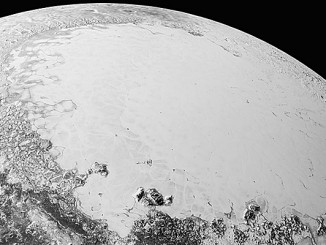
Latest New Horizons images of Pluto and Charon delight and amaze

New close-up images of Pluto from NASA’s New Horizons spacecraft reveal a bewildering variety of surface features that have scientists reeling because of their range and complexity. Images downlinked in the past few days reveal new features as diverse as possible dunes, nitrogen ice flows oozing out of mountainous regions onto plains, and even networks of valleys possibly carved by material flowing over Pluto’s surface.

Picture This

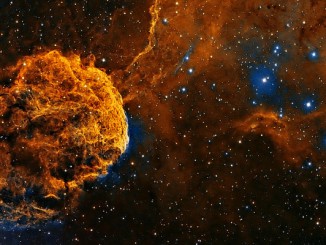
“IC 443” by Patrick Gilliland

Nomination number 13 from the prestigious Insight Astronomy Photographer of the Year competition, an annual celebration of the most beautiful and spectacular visions of the cosmos by astrophotographers worldwide. The 2015 competition received 2700 spectacular entries from over 60 countries and the winners will be announced 17 September.
News

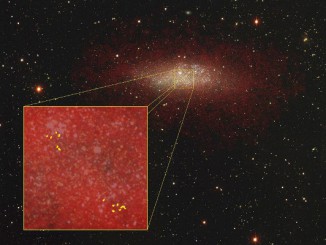
Dwarf galaxy WLM becomes star-forming powerhouse

Nearby dwarf galaxy Wolf—Lundmark—Melotte (WLM) poses an intriguing mystery: How is it able to form brilliant star clusters without the dusty, gas-rich environments found in larger galaxies? The answer, astronomers believe, lies in densely packed and previously unrecognised nuggets of star-forming material sprinkled throughout the galaxy.

News

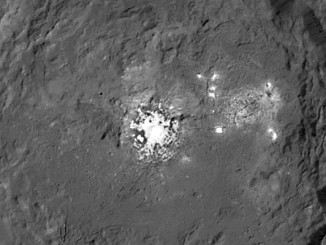
Ceres’ bright spots seen in striking new detail

The brightest spots on the dwarf planet Ceres gleam with mystery in new views delivered by NASA’s Dawn spacecraft. These closest-yet views of 57-mile-wide impact crater Occator, with a resolution of 450 feet (140 metres) per pixel, give scientists a deeper perspective on these very unusual features — though the precise nature of the spots remains unknown.

Observing

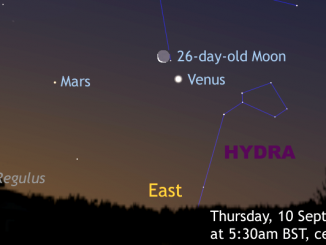
See the Moon & Venus get close in the pre-dawn sky

As dawn creeps across Western Europe on the morning of Thursday, 10 September, a close conjunction of the two brightest objects in the nighttime sky is taking place low in the east an hour before sunrise. So, set your alarm for 5:30am in the UK to see a beautiful juxtaposition of a 26-day-old waning crescent Moon and dazzling planet Venus in the twilight.