News

‘Cannibalism’ between stars

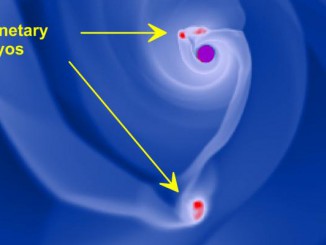
Stars are born inside a rotating cloud of interstellar gas and dust. Before finding itself on the star, however, most of the cloud lands onto a circumstellar disc forming around the star. The manner in which the material is transported through the disc onto the star, causing the star to grow in mass, has recently become a major research topic in astrophysics.

Observing

A guide to our updated interactive Almanac

If the current alignment of all the bright naked-eye planets — Mercury, Venus, Mars, Jupiter and Saturn — in the morning sky has prompted you to speculate where in the world might be the best place to view the spectacle, here’s a guide to using our upgraded interactive Almanac to help you find out.

Picture This

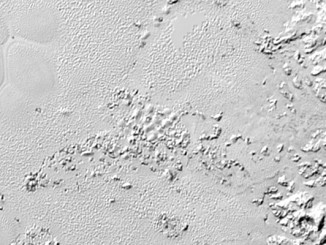
Pluto’s mysterious, floating hills

The nitrogen ice glaciers on Pluto appear to carry an intriguing cargo: numerous, isolated hills that may be fragments of water ice from Pluto’s surrounding uplands. Since water ice is less dense than nitrogen-dominated ice, scientists believe these water ice hills are floating in a sea of frozen nitrogen and move over time like icebergs in Earth’s Arctic Ocean.

News

No large caverns found inside Comet 67P

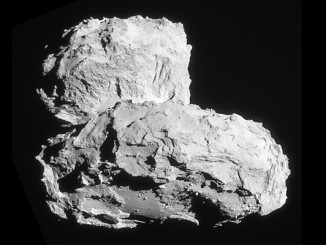
Comets are known to be a mixture of dust and ice, and if fully compact, they would be heavier than water. However, measurements have shown some of them to have densities much lower than that of water ice, implying that comets must be highly porous. A new study of low-density Comet 67P/Churyumov-Gerasimenko using data from ESA’s Rosetta spacecraft rules out a cavernous interior.

News

James Webb Space Telescope primary mirror fully assembled

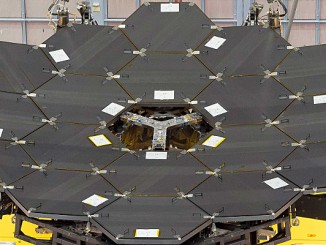
The final primary mirror segment is installed on NASA’s James Webb Space Telescope. Once in space and fully deployed, the 18 hexagonal-shaped mirror segments will work together as one large 6.5-metre mirror. The crowning mirror installation marks an important milestone in the assembly of what will be the biggest and most powerful space telescope ever launched.

News

Mystery within the deep-frozen ‘Flying Saucer’

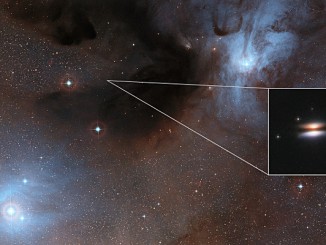
Astronomers have made the first direct measurement of the temperature of large dust grains in the outer parts of a planet-forming disc around a young star. Observations of an object nicknamed the Flying Saucer reveals that the grains are much colder than expected. This surprising result suggests that models of these discs may need to be revised.

News

Saturn’s rings: less than meets the eye?

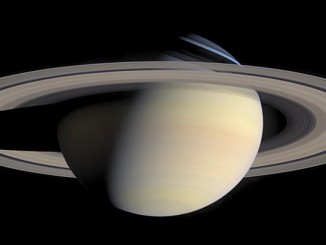
You might think that, in the rings of Saturn, more opaque areas contain a greater concentration of material than places where the rings seem more transparent. But this intuition does not always apply, according to a recent study of the rings using data from NASA’s Cassini mission. The research also suggests that the planet’s brightest B ring could be a few hundred million years old instead of a few billion.

News

Blast from black hole in distant Pictor A galaxy

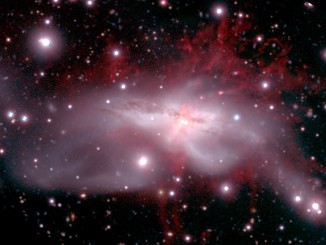
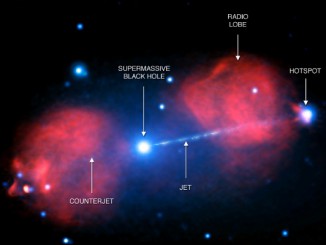
By combining X-ray data from NASA’s Chandra X-ray Observatory over a 15-year period with radio data from the Australia Telescope Compact Array, astronomers have a better understanding of the active galaxy Pictor A, the supermassive black hole at its core and the enormous jet of particles it generates travelling at nearly the speed of light into intergalactic space.