Observing

Make the most of your Jupiter observations during May

Now two months past opposition, the solar system’s largest planet, Jupiter, is highest in the UK sky before sunset and is already descending in the southwest by the time the sky is dark enough to observe it. However, there is still phenomena of the Galilean moons to see and the planet’s Great Red Spot, so make the most of your Jovian observations while you can during May.
Uncategorized

How to view the transit of Mercury online on 9 May

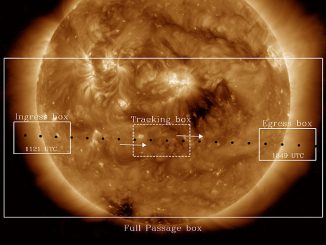
The 2016 transit of Mercury is upon us! With fine weather predicted across a large swathe of the British Isles, many will enjoy clear skies for at least some of this 7½-hour event. But if you don’t have a suitably equipped telescope, or are unable to attend any of the transit-viewing activities organised nationwide, you can still view the phenomenon online.

News

Astronomers detect double ‘peanut shell’ galaxies

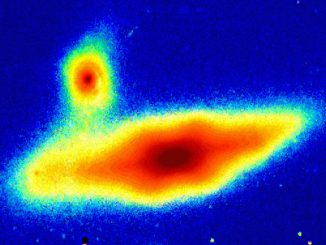
Astronomers at Swinburne University of Technology, Melbourne, have discovered an unusually shaped structure in two nearby disc galaxies. The Swinburne team recently developed new imaging software, making it possible to observe the double “peanut shell shape” formed by the distribution of stars bulging from the centres of these galaxies.

Uncategorized

Where to view the transit of Mercury on 9 May

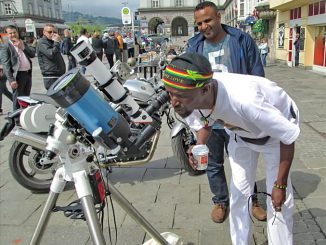
With the transit of Mercury just two days away, interest in this comparatively rare event is growing fast. Given the favourable timing of this 7½-hour phenomenon for the UK, many will be able to view it at lunchtime or after work. If you don’t have suitably equipped telescope, join one of the many transit-viewing activities hosted by astronomical organisations nationwide.

Observing

How and when to observe the transit of Mercury on 9 May

On Monday, 9 May just after midday BST, suitably equipped observers in the British Isles can witness the start of a 7½-hour spectacle that hasn’t been seen for almost a decade — the silhouette of innermost planet Mercury crossing the face of the Sun. Here’s our online guide to observing this fascinating and comparatively rare event in complete safety.

News

ALMA measures mass of black hole with extreme precision

Using the Atacama Large Millimetre/submillimetre Array (ALMA), a team of astronomers has delved remarkably deep into the heart of a nearby elliptical galaxy to study the motion of a disc of gas encircling the supermassive black hole at its centre. These observations provide one of the most accurate mass measurements to date for a black hole outside of our galaxy.

News

Pluto’s interactions with the solar wind are unique

Using data gathered by NASA’s New Horizons spacecraft on its Pluto flyby in July 2015, the dwarf planet has some characteristics less like that of a comet and more like much larger planets, according to the first analysis of Pluto’s unique interaction with the solar wind — the charged particles that spew off from the Sun into the solar system at a supersonic 1 million mph.

News

‘Starspot’ images of nearby star give insights into early Sun

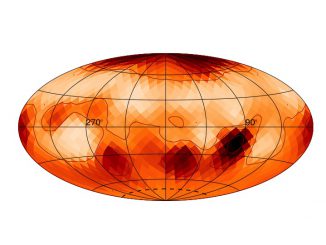
Astronomers have used interferometry to create a time-lapse of the nearby star zeta Andromedae over one of its 18-day rotations that show starspots — sunspots outside our solar system. The pattern of spots on the star is very different from their typical arrangement on our Sun, challenging current theories of how stars’ magnetic fields influence their evolution.