News

Universe’s first life might have been born on carbon planets

Our Earth consists of silicate rocks and an iron core with a thin veneer of water and life, but the first potentially habitable worlds to form might have been very different. New research suggests that the early universe might have contained carbon planets consisting of graphite, carbides, and diamond. Astronomers might find these diamond worlds by searching a rare class of stars.
News

New algorithm could construct first images of black holes

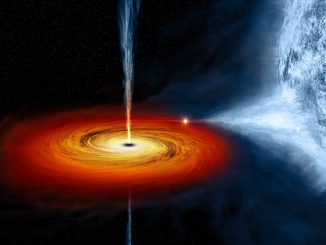
Researchers from MIT and Harvard University have developed a new algorithm that could help astronomers produce the first image of a black hole. The algorithm would stitch together data collected from radio telescopes scattered around the globe in an international collaboration called the Event Horizon Telescope. The project seeks, essentially, to turn the entire planet into a large radio telescope dish.

News

Astronomers measure and model a blazing gamma-ray source

A blazar is a galaxy whose central supermassive black hole emits a powerful jet of high velocity particles aimed almost directly at Earth. Astronomers have measured and successfully modelled the very high energy gamma ray emission from a blazar known as 1ES 1741+196 using VERITAS, the Very Energetic Radiation Imaging Telescope Array System.

Picture This

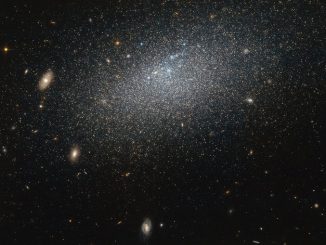
A mysterious solitary galaxy in Ursa Major

The drizzle of stars scattered across this image forms an irregular dwarf galaxy known as UGC 4879. Some 2.3 million light-years from its closest neighbour, UGC 4879’s isolation means that it has not interacted with any surrounding galaxies, making it an ideal laboratory for astronomers looking to understand the complex mysteries of starbirth throughout the universe.

Observing

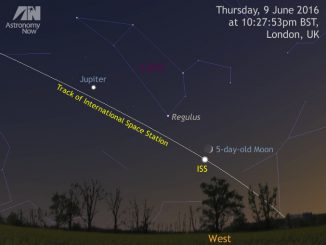
See the International Space Station over the UK

In recent nights, observers in the UK and Western Europe have seen the International Space Station (ISS) as a bright naked-eye ‘star’ moving slowly across the sky from west to east. On Thursday, 9 June, London is favoured for some close approaches of the ISS to the Moon, Jupiter and Saturn. If you see the Station, spare a thought for Tim Peake and the Expedition 47 crew on board!

Picture This

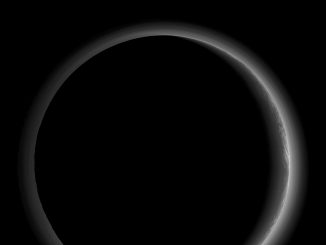
Pluto’s “Twilight Zone” reveals its secrets

NASA’s New Horizons spacecraft took this stunning image mere minutes after closest approach on 14 July 2015. Seen here, sunlight filters through and illuminates Pluto’s complex atmospheric haze layers over portions of the nitrogen ice plains informally named Sputnik Planum, as well as mountains of the informally named Norgay Montes.

News

Hubble finds universe is expanding faster than expected

When Edwin Hubble discovered nearly 100 years ago that the universe was uniformly expanding in all directions, the finding was a big surprise. Then, in the mid-1990s, another shocker occurred: astronomers found that the expansion rate was accelerating, perhaps due to “dark energy.” Now, the latest measurements of our runaway universe suggest that it is expanding faster than astronomers thought.

Picture This

A new ‘Einstein ring’ is discovered

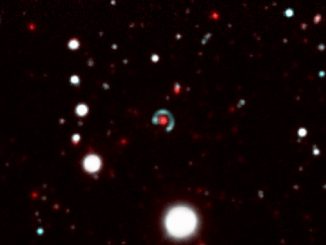
This unusual phenomenon, predicted by Einstein’s theory of General Relativity, was discovered by chance by doctoral student Margherita Bettinelli at the Instituto de Astrofísica de Canarias while analysing images of the Sculptor dwarf galaxy. The “Canarias Einstein ring” is one of the most symmetrical discovered until now and is almost circular.

News

How comets break up and make up

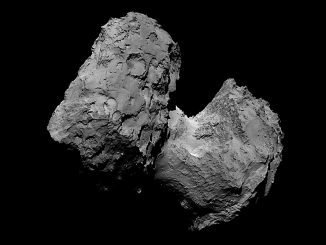
For some comets, breaking up is not that hard to do. A new study indicates that the bodies of some periodic comets — objects that orbit the Sun in less than 200 years — may regularly split in two, then reunite down the road. This may be a repeating process fundamental to comet evolution.