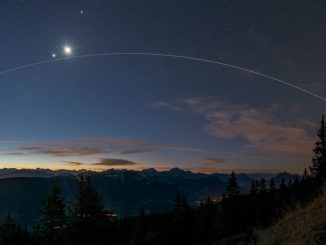
Picture This

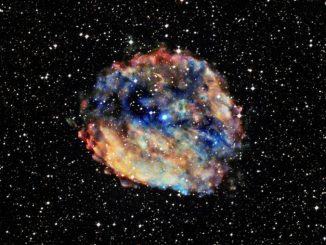
Using X-ray observatories, astronomers have found evidence for what is likely one of the most extreme pulsars, or rotating neutron stars, ever detected. The source exhibits properties of a highly magnetised neutron star, or magnetar, yet its deduced spin period of 6⅔ hours is thousands of times longer than any pulsar ever observed.

A hundred days have passed since Mars was closest to Earth this year, but the Red Planet can still be seen in the early evening sky close to the jewel of the solar system, Saturn. If you wish to identify this pair of planets, then a convenient celestial marker in the form of the waxing crescent Moon passes by on the evenings of 8—9 September in the UK and Western Europe.

It is only as recently as 2013 that astrophysicists found individual black holes in globular clusters via rare phenomena in which a companion star donates material to the black hole. New research by the University of Surrey on a globular cluster known as NGC 6101 shows that it could host several hundred black holes — a phenomenon that until recently was thought impossible.

A fossilised remnant of the early Milky Way harbouring stars of hugely different ages has been revealed by an international team of astronomers. Terzan 5 resembles a globular cluster, but is unlike any other cluster known. It contains stars remarkably similar to the most ancient stars in the Milky Way and bridges the gap in understanding between our galaxy’s past and its present.

Brown dwarfs are sometimes called failed stars as they are too small to sustain the hydrogen fusion process that powers stars. Their temperatures can range from nearly as hot as a star to as cool as a planet and their masses also range between star-like and giant-planet-like. A near-infrared survey has discovered several ultracool brown dwarfs in the Sun’s vicinity.

How did carbon-based life develop on Earth, given that most of the planet’s carbon should have either boiled away in the planet’s earliest days or become locked in Earth’s core? A new study suggests all of the planet’s life-giving carbon came from a collision with an embryonic planet similar to Mercury approximately 4.4 billion years ago.
© 2019 Pole Star Publications Limited