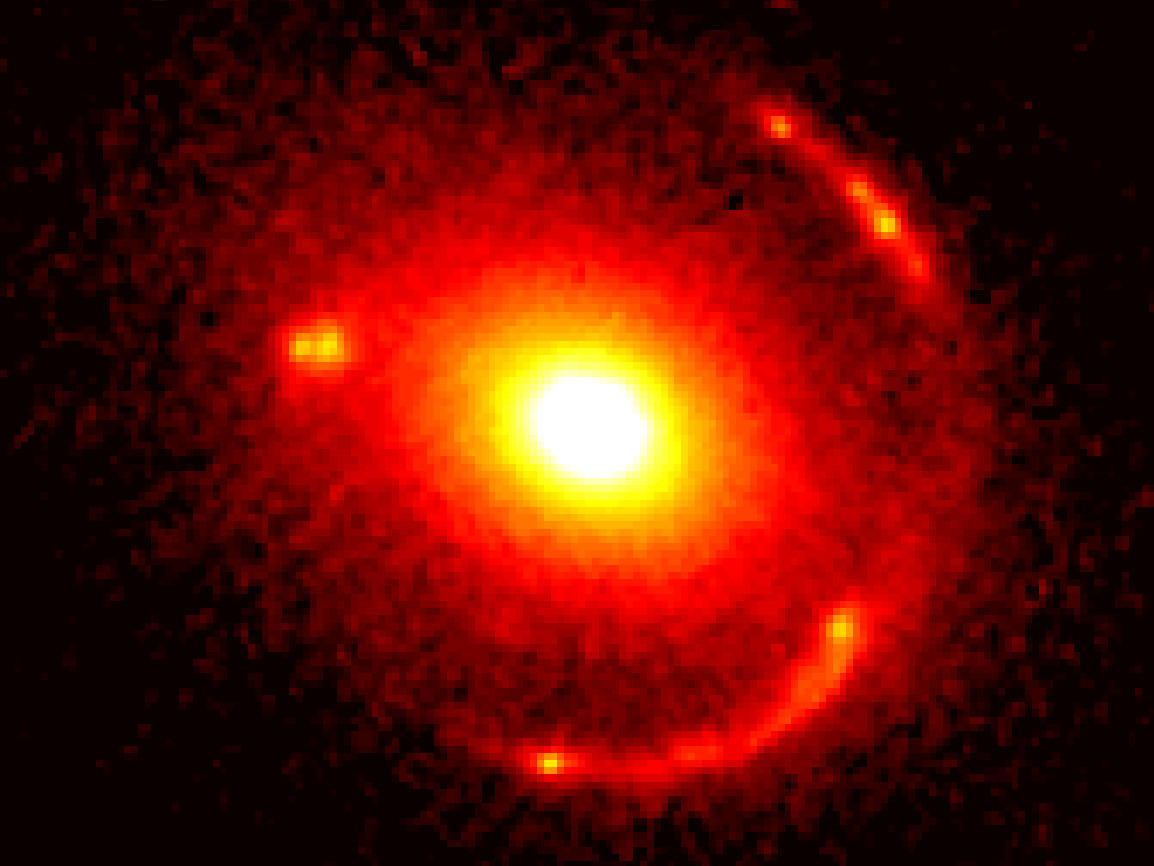
A Hubble Space Telescope image of the strong gravitational lens ER-0047-2808. Pictured in the centre of the image is the strong lens galaxy, whose mass is responsible for the deflection of the background source’s light. The multiply-imaged source galaxy can be seen three times, as an extended arc to the south, a smaller arc to the north-east and two compact clumps of the light to the west. Image credit: ESA/NASA/HST/STScI.The European Space Agency’s Euclid satellite, due for launch in 2020, will set astronomers a huge challenge: to analyse one hundred thousand strong gravitational lenses. The gravitational deflection of light from distant astronomical sources by interposing massive galaxies (strong lenses) can create multiple images of the source that are not just visually stunning, but are also valuable tools for probing our universe. Now, in preparation for Euclid’s challenge, researchers from the University of Nottingham have developed ‘AutoLens,’ the first fully-automated analysis software for strong gravitational lenses. James Nightingale presented the first results from AutoLens at the National Astronomy Meeting 2016 in Nottingham.
“AutoLens has demonstrated its capabilities with this stunning image of a strong gravitational lens system captured by the Hubble Space Telescope,” said Nightingale, who developed AutoLens together with his colleague, Dr. Simon Dye. “The software’s reconstruction of the lensed source reveals in detail a distant pair of star-forming galaxies that are possibly in the early stages of merging. Within the lensed image of the source are small-scale distortions, which encode an imprint of how the lens galaxy’s mass is distributed. AutoLens has a novel new approach to exploit this imprinted information and can accurately measure the distribution of dark matter in the lensing galaxy.”AutoLens Source Reconstruction of the strong gravitational lens ER-0047-2808. The source is reconstructed using an adaptive pixel grid, which rebuilds the source’s light using free-form pixels of any shape, size or tessellation. The reconstruction reveals two distinct galaxies under-going a major merger in the distant universe. Image credit: ESA/NASA/HST/STScI.Historically, the analysis of strongly lensed images has been a very time consuming process, requiring a large amount of manual input to study just one system. To date, only around two hundred strong lens systems have been analysed. AutoLens can be run on ‘massively parallel’ computing architecture that uses multiple processors and requires no user input, so will be able to manage the huge amount of data delivered by the Euclid mission.
“Some of astronomy’s most important results in the past five years have come from studying a handful of strong lenses. This small sample has allowed us to start to unravel the dark matter content of galaxies and the complex physics that drives their formation and evolution,” said Nightingale. “It will be breathtaking to embark on a study of up to one hundred thousand such systems. We can only speculate as to what it will reveal about the nature of dark matter and its role in galaxy evolution.”
A team of international scientists, led by astronomers from Cardiff University, has shown for the first time that galaxies can change their structure over the course of their lifetime. The researchers have shown that a large proportion of galaxies have undergone a major ‘metamorphosis’ since they were initially formed after the Big Bang.
Each year, NASA’s Chandra X-ray Observatory helps celebrate American Archive Month by releasing a collection of images using X-ray data. Each of these six new images — representing just a small fraction of the treasures that reside in Chandra’s unique archive — also includes data from telescopes covering other parts of the electromagnetic spectrum, such as visible and infrared light.
A newly released “deep field” image from the Hubble Space Telescope captures galaxies during the epoch of massive star formation three billion years after the Big Bang.