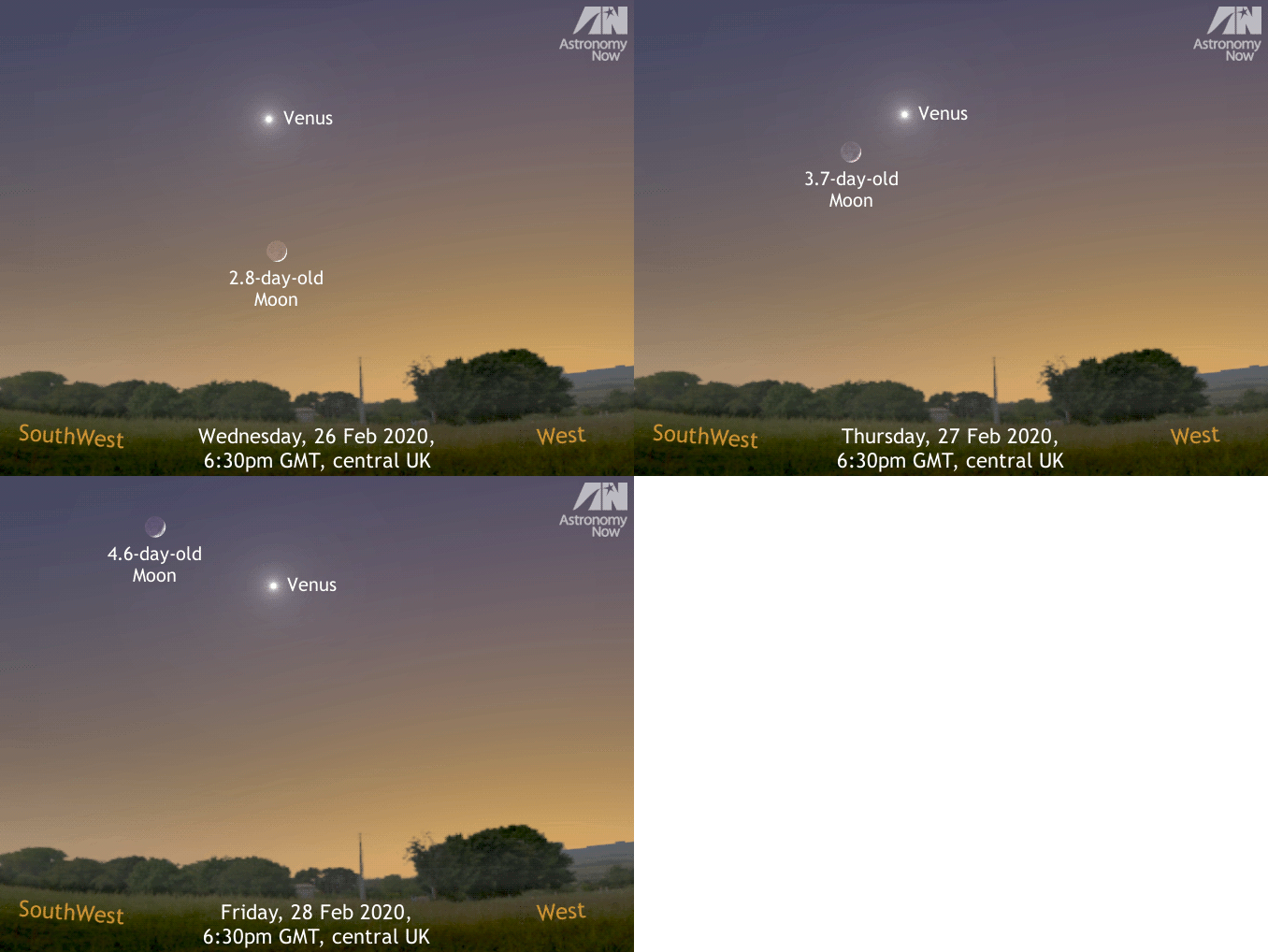
For three evenings from 26–28 February 2020, observers in Western Europe including the British Isles can watch the waxing crescent Moon’s changing configuration with Venus. The Moon and Venus are closest for UK-based observers at 8pm GMT (20h UT) on Thursday, 27 February when their separation is 6¼ degrees, hence users of low-power 7× binoculars can fit the pair in the same field of view. Note that the Moon’s apparent size is enlarged for clarity in this looping animation. AN graphic by Ade Ashford.Brightest planet Venus’ dominance over the west-southwest horizon at dusk is about to be challenged by a young lunar crescent. New Moon occurs on 23 February, so Northern Hemisphere observers can take advantage of the ecliptic’s currently steep inclination to the western horizon soon after sunset to view the Moon’s rapid ascent into the twilight sky.
While you might just catch a glimpse of the almost 2-day-old Moon very low in the west-southwest around the end of civil twilight (some 40 minutes after sunset for the UK) on 25 February, it will be unmissable at civil dusk on the 26th some 12 degrees below the brightest planet.
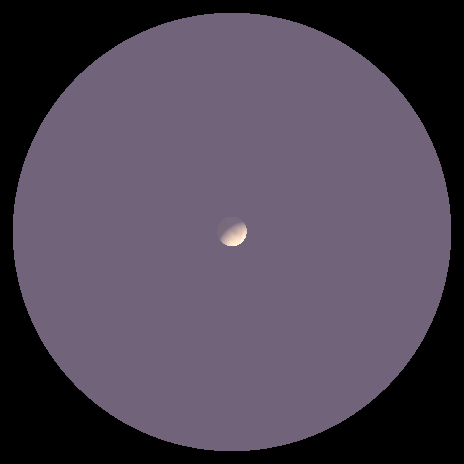
Simulated high-power erect-image telescope view of Venus on 27 February 2020 at 6:30pm GMT. At the time the planet shines at magnitude -4.2, has an angular diameter of 18.5 arcseconds and presents a 64 percent-illuminated gibbous disc. A telescope magnifying 96× is required to enlarge Venus to the same size as the adjacent Moon appears to the naked eye. AN graphic by Ade Ashford.Venus and the 3-day-old crescent Moon are closest for skywatchers in the British Isles at dusk on Thursday, 27 February when their angular separation is just 6¼ degrees, hence users of low-power 7×35 or 7×50 binoculars can view this celestial pairing in the same field of view.
If you own a telescope, you can take advantage of the fact that a magnification of almost 100× is all that’s required to enlarge Venus to the same apparent size as the Moon appears to the unaided eye. At a dazzling magnitude -4.2, the planet’s glare and poor seeing might make it difficult to discern Venus’ shape, but with calm air and good optics you’ll see that it appears like a miniature gibbous Moon.
If you succeed in viewing Venus and the Moon closest together at dusk on 27 February against the stars of Pisces, give pause to contemplate that the brightest planet is almost 3½ times the diameter of our 3,474 kilometre-wide Moon, but Venus currently lies 335 times farther away from Earth.
Friday, 27 July sees the second total lunar eclipse of 2018, which also happens to be the longest of the 21st century. Observers in Antarctica, Australasia, Russia, Asia, Africa, Scandanavia, Europe, Central and Eastern South America will see the event. The Moon rises at mid-eclipse as seen from the British Isles, some 6 degrees north of Mars at opposition.
Astronomers believe that the Earth-Moon system was created in a giant impact 4.5 billion years ago. Southwest Research Institute scientists combined dynamical, thermal, and chemical models of the Moon’s formation to explain the relative lack of volatile elements like potassium, sodium, and zinc in lunar rocks, when compared to those of Earth.
With just a month to go until the 2016 opposition of Mars, the Red Planet is now visible very low in the southeast before midnight for observers in the heart of the UK. Mars and ringed planet Saturn are presently separated by just over 7 degrees — a low power, wide-angle binocular field of view. The waning gibbous Moon passes by on the mornings of 25—26 April.