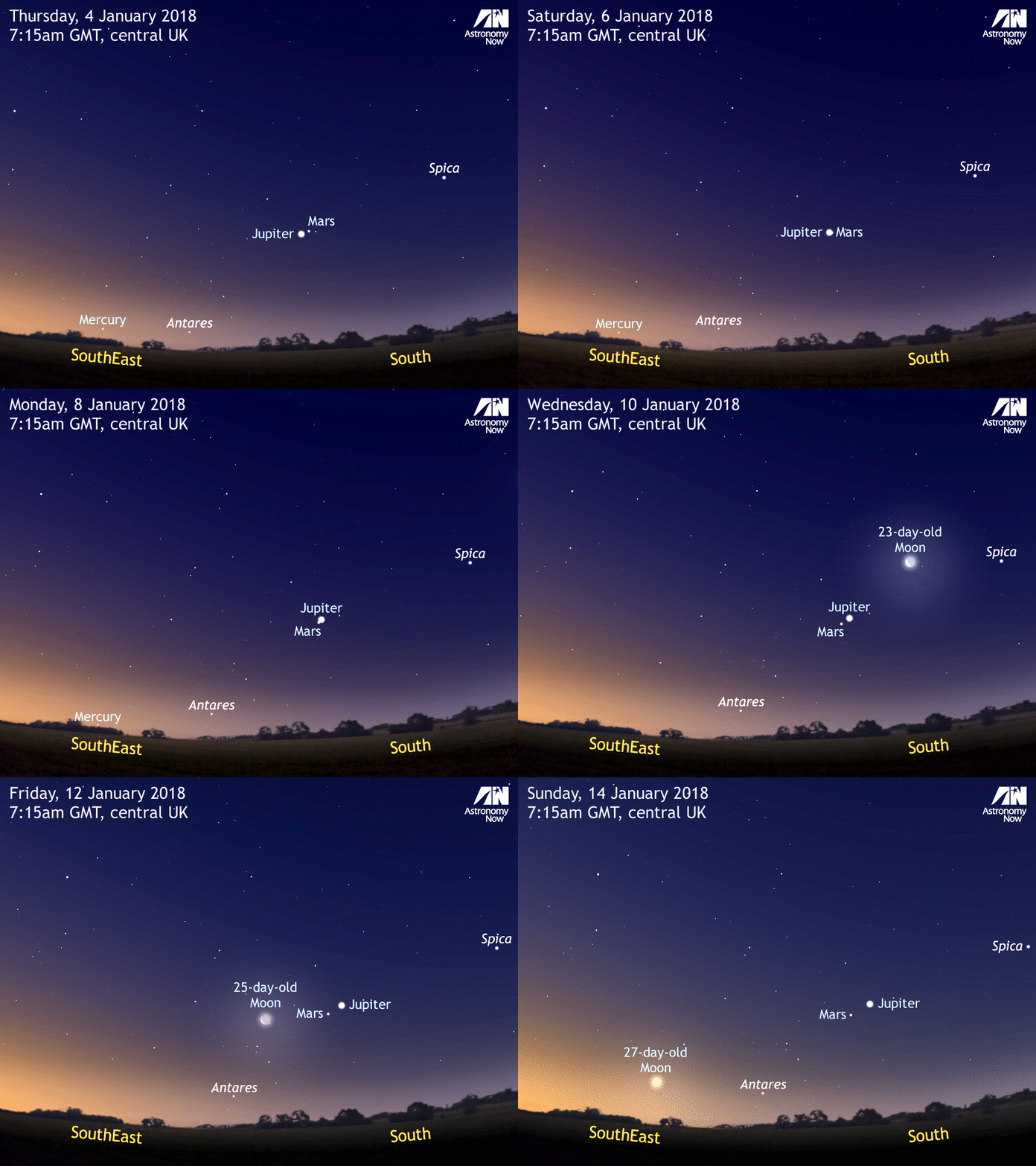
This looping animation depicts the naked-eye view to the south-southeast as seen from the heart of the British Isles at 7:15am GMT from 4 to 14 January 2018. Mercury, the Solar System’s innermost planet, is visible very close to the southeast horizon until about 10 January for UK observers. Mars passes just 12 arcminutes (one-fifth of a degree) south of Jupiter on 7 January, and the 24-day-old waning crescent Moon joins the planetary pair for a glorious conjunction in the southern sky on 11 January. Note that the Moon’s size is slightly enlarged for clarity. AN graphic by Ade Ashford.It currently pays to be an early riser if you wish to view the planets, for it’s all happening at dawn in the skies of Western Europe. Observers in the UK wishing to get the best views should find a location that offers an unobstructed southeasterly aspect where, if you are blessed with clear skies between 7am GMT and sunrise, you could see Mercury, Mars and Jupiter in addition to a waning Moon.
Jupiter is the bright magnitude -1.8 ‘star’ in the constellation of Libra currently visible in the south-southeast around 7am GMT. Look carefully at the Solar System’s largest planet over the next few mornings and you’ll notice another celestial body closing in on it: Mars. At magnitude +1.4, the Red Planet is presently nineteen times fainter than Jupiter.
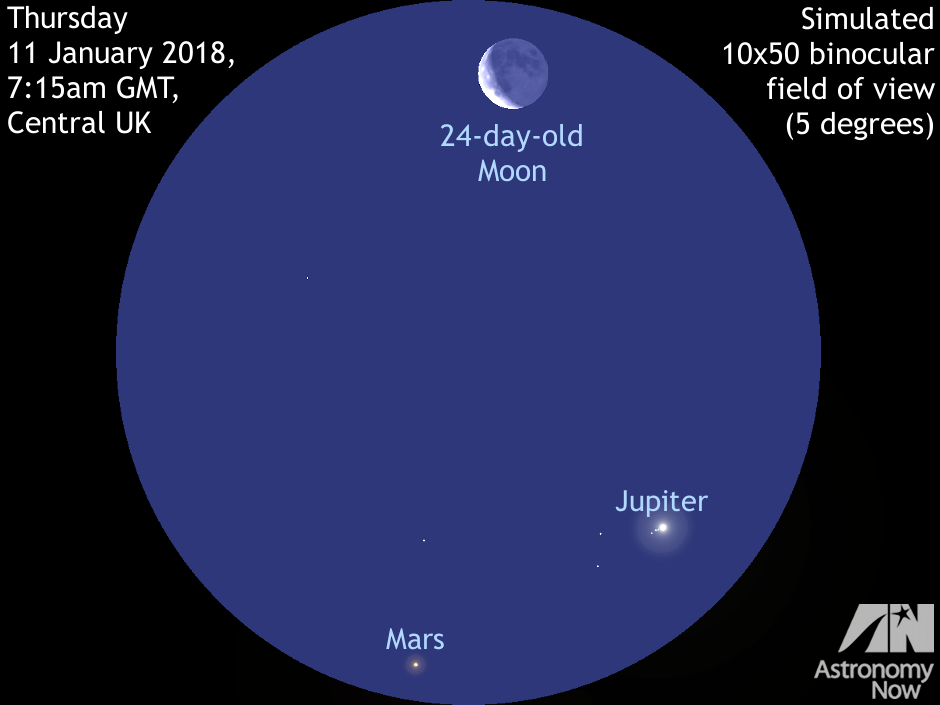
In the UK dawn twilight of Thursday, 11 January, Mars and Jupiter lie 2 degrees apart. In this simulated 10×50 binocular field of view, you’ll also fit in the 24-day-old waning crescent Moon. With higher magnification binoculars and small telescopes, you’ll also see all four of Jupiter’s Galilean moons strung out in a line on one side of the planet. In order of separation from Jupiter they are Io, Europa, Ganymede and Callisto — on this occasion matching the arrangement of their orbits about the largest planet. Click the graphic for a full size version. AN graphic by Ade Ashford.Mars passes just 12 arcminutes (that’s one-fifth of a degree, or 40 percent of the full Moon’s diameter) south of its larger planetary sibling in the small hours of Sunday, 7 January. By civil dawn in the British Isles that day the gap between the pair will have widened to 14½ arcminutes, or slightly less than half the apparent size of the full Moon. Don’t miss Jupiter and Mars in the same telescope field of view at magnifications up to about 175x!
While the gap between Mars and Jupiter widens after 7 January, keep your eye on the waning lunar crescent. The 24-day-old Moon joins the planetary pair for a glorious conjunction in the southern sky on Thursday, 11 January. The conjunction is so close that owners of binoculars magnifying up to 10x will have no difficulty seeing the trio in the same field of view, but it will still look fabulous with the naked eye.
Innermost planet Mercury puts on its best morning display of the year for Northern Hemisphere observers from late November to early December. Skywatchers in the British Isles should find a location offering an unobstructed view of the southeast horizon about 45 minutes before sunrise to get the best views, with the Red Planet and star Spica – the brightest in Virgo – also nearby.
On Saturday, 2 March 2019, observers in Western Europe should seek a location offering a level and unobstructed southeastern view at civil dawn (some 36 minutes before sunrise in the heart of the UK) to have a chance of seeing the 25-day-old waning crescent Moon between Venus in Capricornus and Saturn in Sagittarius with the unaided eye.
A hundred days have passed since Mars was closest to Earth this year, but the Red Planet can still be seen in the early evening sky close to the jewel of the solar system, Saturn. If you wish to identify this pair of planets, then a convenient celestial marker in the form of the waxing crescent Moon passes by on the evenings of 8—9 September in the UK and Western Europe.