Astronomers discovered a real “tell-tale heart” in space, 6,500 light-years from Earth. The “heart” is the crushed core of a long-dead star, called a neutron star, which exploded as a supernova and is now still beating with rhythmic precision. Evidence of its heartbeat are rapid-fire, lighthouse-like pulses of energy from the fast-spinning neutron star. The stellar relic is embedded in the centre of the Crab Nebula, the expanding, tattered remains of the doomed star. Image credits: NASA and ESA, Acknowledgment: M. Weisskopf/Marshall Space Flight Center.The eerie glow of a dead star, which exploded long ago as a supernova, reveals itself in this NASA Hubble Space Telescope image of the Crab Nebula. But don’t be fooled. The ghoulish-looking object still has a pulse. Buried at its centre is the star’s telltale heart, which beats with rhythmic precision.
The “heart” is the crushed core of the exploded star. Called a neutron star, it has about the same mass as the Sun but is squeezed into an ultra-dense sphere that is only a few miles across and 100 billion times stronger than steel. The tiny powerhouse is the bright star-like object near the centre of the image.
This surviving remnant is a tremendous dynamo, spinning 30 times a second. The wildly whirling object produces a deadly magnetic field that generates an electrifying 1 trillion volts. This energetic activity unleashes wisp-like waves that form an expanding ring, most easily seen to the upper right of the pulsar. The nebula’s hot gas glows in radiation across the electromagnetic spectrum, from radio to X-rays. The Hubble observations were taken in visible light as black-and-white exposures. The Advanced Camera for Surveys made the observations between January and September 2012. The green hue has been added to give the image a Halloween theme.This time-lapse movie of the Crab Nebula, made from NASA Hubble Space Telescope observations, reveals wave-like structures expanding outward from the “heart” of an exploded star. The waves look like ripples in a pond. The heart is the crushed core of the exploded star, or supernova. Called a neutron star, it has about the same mass as the Sun but is squeezed into an ultra-dense sphere that is only a few miles across and 100 billion times stronger than steel. This surviving relic is a tremendous dynamo, spinning 30 times a second. The rapidly spinning neutron star is visible in the image as the bright object just below centre. The bright object to the left of the neutron star is a foreground or background star. The movie is assembled from ten Hubble exposures taken between September and November 2005 by the Advanced Camera for Surveys. Image credits: NASA and ESA, Acknowledgment: J. Hester (Arizona State University).The Crab Nebula is one of the most historic and intensively studied supernova remnants. Observations of the nebula date back to 1054 A.D., when Chinese astronomers first recorded seeing a “guest star” during the daytime for 23 days. The star appeared six times brighter than Venus. Japanese, Arabic, and Native American stargazers also recorded seeing the mystery star. In 1758, while searching for a comet, French astronomer Charles Messier discovered a hazy nebula near the location of the long-vanished supernova. He later added the nebula to his celestial catalogue as “Messier 1,” marking it as a “fake comet.” Nearly a century later British astronomer William Parsons sketched the nebula. Its resemblance to a crustacean led to M1’s other name, the Crab Nebula. In 1928 astronomer Edwin Hubble first proposed associating the Crab Nebula to the Chinese “guest star” of 1054.
The nebula, bright enough to be visible in amateur telescopes, is located 6,500 light-years away in the constellation of Taurus.
Most of the cosmic rays arriving at Earth from our galaxy come from nearby clusters of massive stars, according to new observations from NASA’s Advanced Composition Explorer (ACE) spacecraft. But the detection of a few radioactive cosmic-ray iron nuclei also indicates that there has been a supernova in our galactic neighbourhood within the last few million years.
NASA’s Rossi X-ray Timing Explorer, decommissioned in 2012, fell back into the atmosphere and burned up 30 April, finally bringing a remarkably successful mission to study black holes and neutron stars to a fiery end.
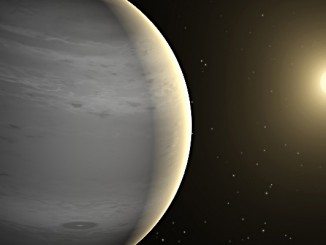
Planets having atmospheres rich in helium may be common in our Galaxy, according to a new theory based on data from NASA’s Spitzer Space Telescope. These planets would be around the mass of Neptune, or lighter, and would orbit close to their stars, basking in their searing heat.