
News

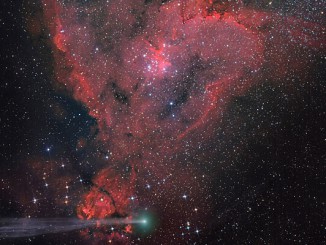
A stunning juxtaposition of an ethereal solar system body, long-period comet C/2014 E2 Jacques, and the vast, heart-shaped emission nebula IC 1805, some 7,500 light-years away in the constellation Cassiopeia — winning image of the Planets, Comets & Asteroids category in the Insight Astronomy Photographer of the Year competition 2015.

In deep space, some unknown astrophysical phenomenon is causing mysterious bursts of energy that appear as short flashes of radio waves. In a University of British Columbia study, researchers propose a new way to calculate cosmological distances using these fast radio bursts. The method allows researchers to position distant galaxies in three dimensions and map out the cosmos.

It is known today that merging galaxies play a large role in their evolution, and the formation of elliptical galaxies in particular. However, there are only a few merging systems close enough to be observed in depth. The pair of interacting galaxies seen here — known as NGC 3921 — is one of these systems. But ‘close’ is a relative term: NGC 3921 lies 270 million light-years away.

A 125-year-old, 18-inch (46-cm) aperture Brashear refracting telescope with an illustrious history that has languished in storage for half a century has found a new Antipodean home. It marks the first step on the road to restoring the 7-ton, 8-metre-long instrument to its former glory, destined to become the centrepiece of a public outreach Astronomy Centre near the shore of Lake Tekapo in the heart of New Zealand’s South Island.
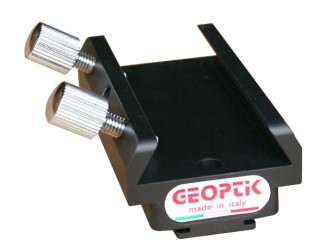
Reviewer Steve Ringwood acknowledges that some stunning astrophotography is possible by use of a camera and its terrestrial lens alone. But in dim nocturnal light, it can be difficult to accurately aim the camera at a particular target in the sky. The Geoptik SLR hotshoe finderscope adapter is a convenient mediator between a DSLR camera and a Synta-style red dot or optical finder’s dovetail for precise pointing.
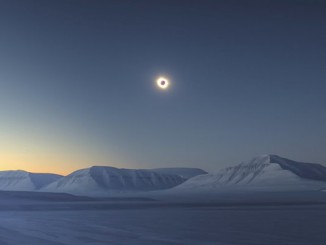
“Eclipse Totality over Sassendalen” is the overall winning picture, making Luc Jamet of France the Insight Astronomy Photographer of the Year 2015. The prestigious annual competition received 2700 spectacular entries from 59 countries this year. The winning images from the 11 categories are showcased at the Royal Observatory Greenwich in an exhibition open 18 September 2015 — 26 June 2016
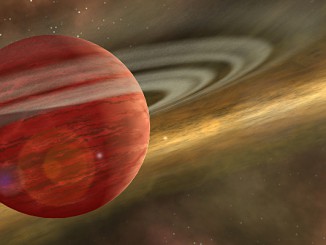
Twenty years after they were first discovered, ‘hot Jupiters’ — gas giant planets that orbit very close to their star — are still enigmatic objects. Using the Canada-France-Hawaii Telescope, an international team of astrophysicists has shown that such bodies may only take several million years to migrate close to their newly formed star.

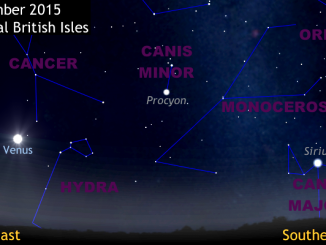
Early risers wishing to see Venus as a dazzling ‘morning star’ need only glance low to the east in the pre-dawn sky. The planet reaches greatest brilliancy on Sunday, 20 September when, for a couple of mornings, it can be seen outshining brightest nighttime star Sirius in the southeast by a factor of seventeen times. Can you see your shadow cast by Venus?
© 2019 Pole Star Publications Limited