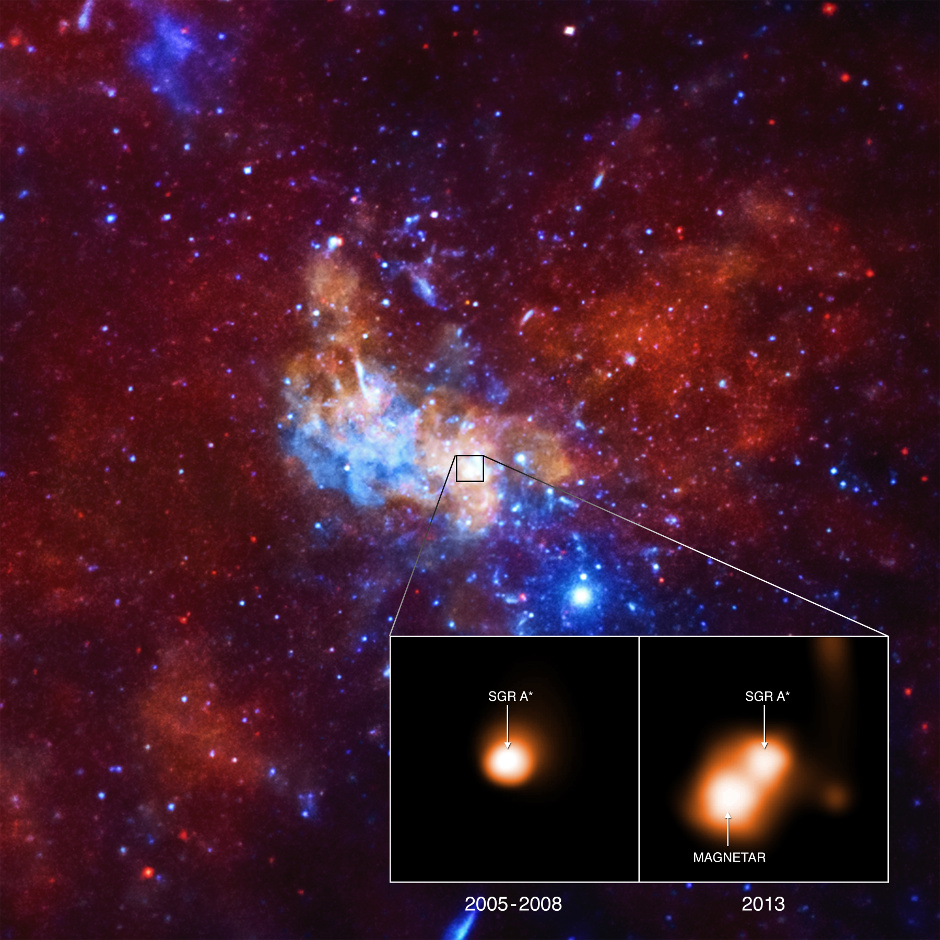
Since its discovery two years ago when it gave off a burst of X-rays, astronomers have been actively monitoring the magnetar, dubbed SGR 1745-2900, with Chandra and the European Space Agency’s XMM-Newton. The main image of the graphic shows the region around the Milky Way’s black hole in X-rays from Chandra (red, green, and blue are the low, medium, and high-energy X-rays respectively). The inset contains Chandra’s close-up look at the area right around the black hole, showing a combined image obtained between 2005 and 2008 (left) when the magnetar was not detected, during a quiescent period, and an observation in 2013 (right) when it was caught as a bright point source during the X-ray outburst that led to its discovery. The main Image is 8 arcmin across (about 61 light-years); Inset image is about 14 arcsec across (1.8 light-years). Image credit: NASA/CXC/INAF/F.Coti Zelati et al.Magnetars are dense, collapsed stars (called “neutron stars”) that possess enormously powerful magnetic fields. At a distance that could be as small as 0.3 light-year (or about 2 trillion miles) from the 4-million-solar mass black hole in the center of our Milky Way galaxy, the magnetar is by far the closest neutron star to a supermassive black hole ever discovered and is likely in its gravitational grip.
Since its discovery two years ago when it gave off a burst of X-rays, astronomers have been actively monitoring the magnetar, dubbed SGR 1745-2900, with Chandra and the European Space Agency’s XMM-Newton. A new study uses long-term monitoring observations to reveal that the amount of X-rays from SGR 1745-2900 is dropping more slowly than other previously observed magnetars, and its surface is hotter than expected.
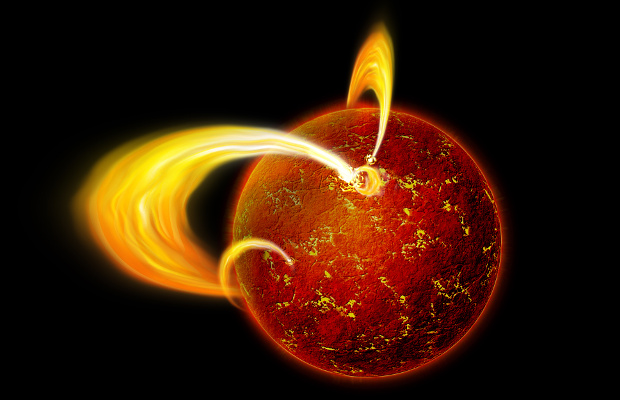
The team first considered whether “starquakes” are able to explain this unusual behaviour. When neutron stars, including magnetars, form, they can develop a tough crust on the outside of the condensed star. Occasionally, this outer crust will crack, similar to how the Earth’s surface can fracture during an earthquake. Although starquakes can explain the change in brightness and cooling seen in many magnetars, the authors found that this mechanism by itself was unable to explain the slow drop in X-ray brightness and the hot crustal temperature. Fading in X-ray brightness and surface cooling occur too quickly in the starquake model.This illustration shows how an extremely rapidly rotating neutron star, which has formed from the collapse of a very massive star, can produce incredibly powerful magnetic fields. Image credit: NASA/CXC/M.Weiss.The researchers suggest that bombardment of the surface of the magnetar by charged particles trapped in twisted bundles of magnetic fields above the surface may provide the additional heating of the magnetar’s surface, and account for the slow decline in X-rays. These twisted bundles of magnetic fields can be generated when the neutron star forms.
The researchers do not think that the magnetar’s unusual behaviour is caused by its proximity to a supermassive black hole, as the distance is still too great for strong interactions via magnetic fields or gravity. Astronomers will continue to study SGR 1745-2900 to glean more clues about what is happening with this magnetar as it orbits our galaxy’s supermassive black hole.
One of best deep-sky objects of the approaching season is the Andromeda Galaxy, or Messier 31, that is now accessible low in the east-northeast by 10pm local time in the UK and Western Europe. Here’s our comprehensive guide to locating this iconic Local Group galaxy.
In this image from ESO’s Very Large Telescope (VLT), light from blazing blue stars energises the gas left over from the stars’ recent formation. The result is a strikingly colourful emission nebula, called LHA 120-N55, in which the stars are adorned with a mantle of glowing gas. LHA 120-N55 lies within the Large Magellanic Cloud, a satellite galaxy of the Milky Way.
Australian scientists have taken a critical step towards understanding why different types of galaxies exist throughout the universe. The research means that astronomers can now classify galaxies according to their physical properties rather than human interpretation of a galaxy’s appearance.