26 August 2026
Astronomy Now
  • Home
  • The Magazine
    • About
    • Current Issue
    • Subscribe
    • Renew Subscription
  • AstroFest 2026
  • News
  • Observing
    • UK Sky Chart
    • Almanac
    • Scope Calc
    • DSLR Calc
  • Reviews
    • Equipment
    • Book Reviews
  • Spaceflight Now
  • Shop
  • Contact Us
    • Subscriptions
    • Your Views
    • Ask Astronomy Now
    • Editorial
    • Advertising
    • AstroListings
Latest News
  • [ 24 August 2026 ] JWST’s ‘impossible’ early galaxies may be even more massive than we thought News
  • [ 7 August 2026 ] How to observe the 12 August 2026 solar eclipse Eclipse
  • [ 5 August 2026 ] Falcon 9 lunar impact: More than a new crater News
  • [ 25 July 2026 ] Euclid opens a new window on the first billion years of cosmic history News
  • [ 10 June 2026 ] Caught in the act: the wind that could kill a galaxy News
  • Facebook
  • Twitter
  • LinkedIn

Scott Sheppard

News

Hunt for Planet 9 reveals extremely distant solar system objects

30 August 2016 Astronomy Now

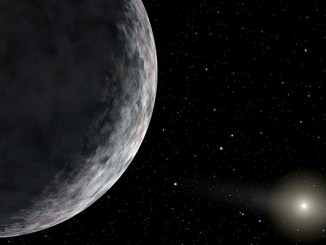
In the race to discover a proposed ninth planet in our solar system, astronomers are conducting the largest, deepest survey for objects beyond Neptune and the Kuiper Belt. Nearly 10 percent of the sky has been explored to date using some of the largest and most advanced telescopes, revealing several never-before-seen objects at extreme distances from the Sun.

News

Evidence for an impact event on main-belt asteroid Griseldis

13 November 2015 Astronomy Now

The main-belt asteroid (493) Griseldis, that lies between the orbits of Mars and Jupiter, was probably hit by another object last March. The results were reported on 12 November at the 47th Annual Meeting of the Division for Planetary Sciences of the American Astronomical Society near Washington, DC.

News

Newly discovered dwarf planet is solar system’s most distant object

12 November 2015 Astronomy Now

Astronomers have found a dwarf planet three times farther away from the Sun than Pluto, making it the most distant known object in the solar system. Designated V774104, the body is 500 to 1000 kilometres in diameter and is currently 15.4 billion kilometres, or 103 astronomical units (AU) from the Sun, but its exact orbit is yet to be determined.

News

Active main-belt asteroid 62412 (2000 SY178) develops a tail

11 November 2014 Ade Ashford

Scott Sheppard and Chadwick Trujillo of Carnegie’s Gemini Observatory present recent observations revealing that main-belt Hygeia-family asteroid 62412 (2000 SY178) has a tail.

Latest Issue

Astronomy Now Newsletter

Get the wonders of the Universe delivered to your inbox.
* indicates required
Which elements of Astronomy interest you?

News Headlines

  • JWST’s ‘impossible’ early galaxies may be even more massive than we thought
    24 August 2026
  • How to observe the 12 August 2026 solar eclipse
    7 August 2026
  • Falcon 9 lunar impact: More than a new crater
    5 August 2026
  • Euclid opens a new window on the first billion years of cosmic history
    25 July 2026
  • Caught in the act: the wind that could kill a galaxy
    10 June 2026

© 2026 Nebula Press Ltd

Astronomy Now