Observing

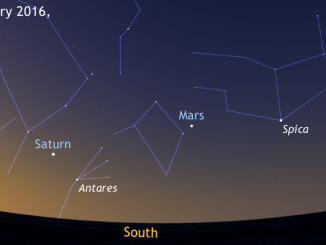
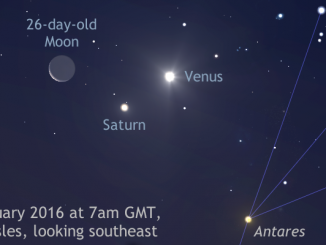
See all five naked-eye planets gathered in the morning sky

All five of the bright naked-eye planets are observable in the pre-dawn sky from about the third week of January 2016, particularly if one lives south of the equator. But even from the UK, you can get to view the spectacle if you time it right — and the weather obliges! The last time that Mercury, Venus, Mars, Jupiter and Saturn appeared in the same sky was 11 years ago.
News

Did the ancient Egyptians record the period of eclipsing binary Algol?

A scholarly investigation of the Cairo Calendar papyrus (1244–1163 B.C.) has led researchers at the University of Helsinki to conclude that the ancient Egyptians were aware that the variable star Algol (beta Persei) had a 2.85-day period. Given that the star’s current period is 2.8673 days, this supports the theory that mass transfer between the stars of this eclipsing binary has caused a long-term increase of its orbital period.

Picture This

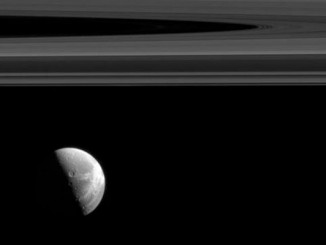
Saturn’s moon Prometheus seen up close

NASA’s Cassini spacecraft spied details on the pockmarked surface of Saturn’s moon Prometheus (86 kilometres, or 53 miles across) during a moderately close flyby on 6 December 2015. This is one of Cassini’s highest resolution views of Prometheus, a moon which orbits Saturn just interior to the narrow F ring, which is seen here at top.