
7 August 2026
Astronomy Now
  • Home
  • The Magazine
    • About
    • Current Issue
    • Subscribe
    • Renew Subscription
  • AstroFest 2026
  • News
  • Observing
    • UK Sky Chart
    • Almanac
    • Scope Calc
    • DSLR Calc
  • Reviews
    • Equipment
    • Book Reviews
  • Spaceflight Now
  • Shop
  • Contact Us
    • Subscriptions
    • Your Views
    • Ask Astronomy Now
    • Editorial
    • Advertising
    • AstroListings
Latest News
  • [ 7 August 2026 ] How to observe the 12 August 2026 solar eclipse Eclipse
  • [ 5 August 2026 ] Falcon 9 lunar impact: More than a new crater News
  • [ 25 July 2026 ] Euclid opens a new window on the first billion years of cosmic history News
  • [ 10 June 2026 ] Caught in the act: the wind that could kill a galaxy News
  • [ 4 June 2026 ] Europe’s Mars rover may land in the remains of a vast ancient water system News
  • Facebook
  • Twitter
  • LinkedIn

Cardiff

Observing

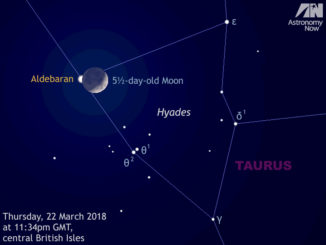
See the setting Moon hide bright star Aldebaran late on 22 March

20 March 2018 Ade Ashford

On Thursday, 22 March observers in the British Isles with clear skies can see the 5½-day-old setting crescent Moon pass in front of first-magnitude star Aldebaran in the constellation of Taurus soon after 11:30pm GMT. Depending on where you live in the UK, you might just see the star reappear again shortly before the pair set.

Latest Issue

Astronomy Now Newsletter

Get the wonders of the Universe delivered to your inbox.
* indicates required
Which elements of Astronomy interest you?

News Headlines

  • How to observe the 12 August 2026 solar eclipse
    7 August 2026
  • Falcon 9 lunar impact: More than a new crater
    5 August 2026
  • Euclid opens a new window on the first billion years of cosmic history
    25 July 2026
  • Caught in the act: the wind that could kill a galaxy
    10 June 2026
  • Europe’s Mars rover may land in the remains of a vast ancient water system
    4 June 2026

© 2026 Nebula Press Ltd

Astronomy Now