
27 August 2026
Astronomy Now
  • Home
  • The Magazine
    • About
    • Current Issue
    • Subscribe
    • Renew Subscription
  • AstroFest 2026
  • News
  • Observing
    • UK Sky Chart
    • Almanac
    • Scope Calc
    • DSLR Calc
  • Reviews
    • Equipment
    • Book Reviews
  • Spaceflight Now
  • Shop
  • Contact Us
    • Subscriptions
    • Your Views
    • Ask Astronomy Now
    • Editorial
    • Advertising
    • AstroListings
Latest News
  • [ 24 August 2026 ] JWST’s ‘impossible’ early galaxies may be even more massive than we thought News
  • [ 7 August 2026 ] How to observe the 12 August 2026 solar eclipse Eclipse
  • [ 5 August 2026 ] Falcon 9 lunar impact: More than a new crater News
  • [ 25 July 2026 ] Euclid opens a new window on the first billion years of cosmic history News
  • [ 10 June 2026 ] Caught in the act: the wind that could kill a galaxy News
  • Facebook
  • Twitter
  • LinkedIn

X-Headlines

News

Hubble discovers ‘wobbling galaxies’

26 October 2017 Astronomy Now

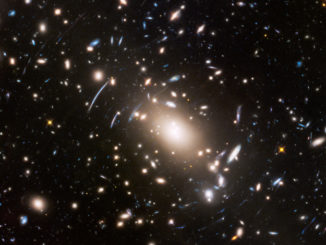
Using the Hubble Space Telescope, astronomers have discovered that the brightest galaxies within galaxy clusters “wobble” relative to the cluster’s centre of mass.

News

Engineers hopeful Mars rover’s drill can return to service

25 October 2017 Stephen Clark

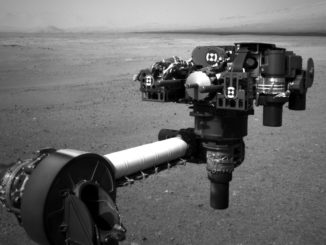
Engineers have started testing a new way to use the Curiosity rover’s drill to bore into Martian rocks after a motor in the device stalled late last year, but ground teams are still months away from the first chance to resume drilling operations.

News

Detector trouble expected to delay ESA’s Euclid dark energy mission

23 October 2017 Stephen Clark

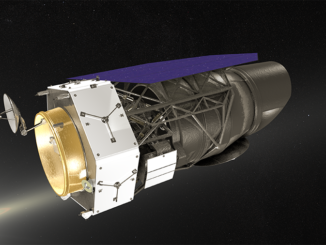
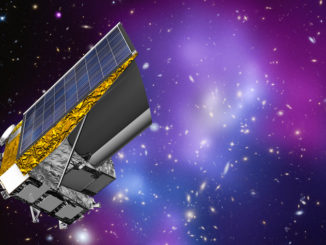
Technical problems discovered during ground testing of U.S.-built detectors for the European Space Agency’s Euclid astronomy mission will delay the completion of the telescope’s scientific payload, jeopardising the observatory’s 2020 launch target, the head of NASA’s astrophysics division said last week.
News

MAVEN mission finds Mars has a twisted tail

23 October 2017 Astronomy Now

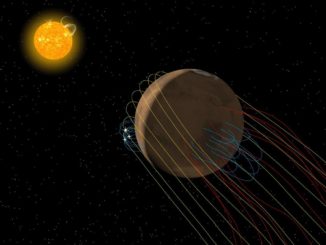
Mars has an invisible magnetic “tail” that is twisted by interaction with the solar wind, according to new research using data from NASA’s MAVEN spacecraft.

News

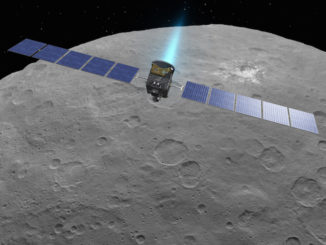
NASA’s Dawn mission gears up for close look at Ceres

20 October 2017 Stephen Clark

NASA’s Dawn spacecraft will remain at Ceres for the rest of its mission, heading closer to the asteroid belt’s largest resident than ever before to obtain new measurements of ice, salts and a tenuous intermittent atmosphere detected around the dwarf planet, the space agency announced Thursday.

News

Cassini results still keeping scientists busy

19 October 2017 Stephen Clark

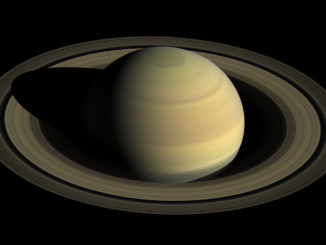
Scientists examining data from the Cassini mission’s final months reported this week unexpected measurements of Saturn’s gravity field and outer atmosphere, suggesting they may have to revisit theories about the planet’s rings and the forces that generate magnetic fields.

News

Examining Mars’ moon Phobos in a different light

17 October 2017 Astronomy Now

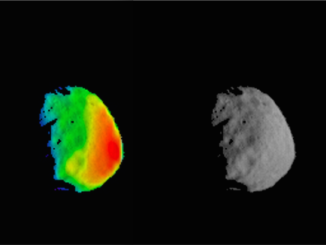
NASA’s longest-lived mission to Mars has gained its first look at the Martian moon Phobos, pursuing a deeper understanding by examining it in infrared wavelengths.

News

Gravitational waves from colliding neutron stars usher in new era of astronomy

16 October 2017 Keith Cooper

For the first time, gravitational waves have been detected coming from the violent collision of two neutron star potentially solving the mystery of where heavy elements like gold come from as well as producing a visible afterglow detected by over 70 telescopes around the world.

News

Intense storms batter Saturn’s largest moon, scientists report

14 October 2017 Astronomy Now

Titan, the largest of Saturn’s more than 60 moons, has surprisingly intense rainstorms, according to research by a team of UCLA planetary scientists and geologists. Although the storms are relatively rare — they occur less than once per Titan year, which is 29 and a half Earth years — they occur much more frequently than the scientists expected.

News

VLBA measurement promises complete picture of the Milky Way

12 October 2017 Astronomy Now

Astronomers using the National Science Foundation’s Very Long Baseline Array have directly measured the distance to a star-forming region on the opposite side of our Milky Way Galaxy from the Sun. Their achievement nearly doubles the previous record for distance measurement within our galaxy.

Posts pagination

« 1 … 6 7 8 … 25 »

Latest Issue

Astronomy Now Newsletter

Get the wonders of the Universe delivered to your inbox.
* indicates required
Which elements of Astronomy interest you?

News Headlines

  • JWST’s ‘impossible’ early galaxies may be even more massive than we thought
    24 August 2026
  • How to observe the 12 August 2026 solar eclipse
    7 August 2026
  • Falcon 9 lunar impact: More than a new crater
    5 August 2026
  • Euclid opens a new window on the first billion years of cosmic history
    25 July 2026
  • Caught in the act: the wind that could kill a galaxy
    10 June 2026

© 2026 Nebula Press Ltd

Astronomy Now