
News


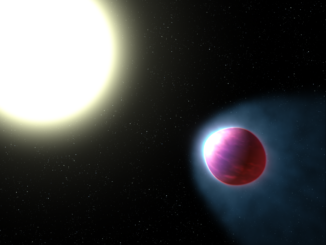

Many rock stars don’t like to play by the rules, and a cosmic one is no exception. A team of astronomers has discovered that an extraordinarily bright supernova occurred in a surprising location. This “heavy metal” supernova discovery challenges current ideas of how and where such super-charged supernovas occur.
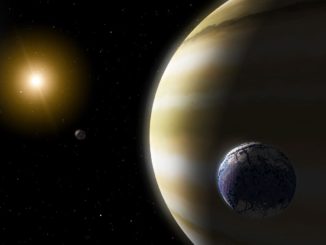
Strong hints have been found of a possible exomoon candidate orbiting a gas giant planet over 4,000 light years away in the constellation of Cygnus the Swan. Should the moon be confirmed later this year by the Hubble Space Telescope, it will be the first moon ever discovered around a planet beyond our Solar System.
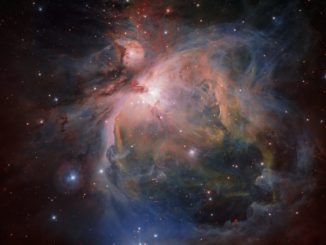

Gamma-ray bursts are among the most energetic and explosive events in the universe. They are also short-lived, lasting from a few milliseconds to about a minute, making it tough for astronomers to observe a gamma-ray burst in detail. Using a wide array of ground- and space-based telescope observations, an international team constructed one of the most detailed descriptions of a gamma-ray burst to date.

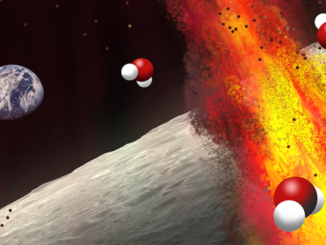
A new study of satellite data finds that numerous volcanic deposits distributed across the surface of the Moon contain unusually high amounts of trapped water compared with surrounding terrains. The finding of water in these ancient deposits, which are believed to consist of glass beads formed by the explosive eruption of magma coming from the deep lunar interior, bolsters the idea that the lunar mantle is surprisingly water-rich.
© 2019 Pole Star Publications Limited