News

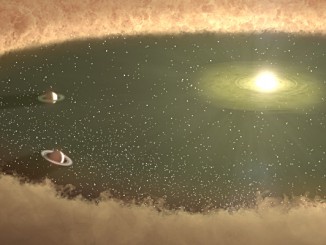
Researchers at Southwest Research Institute (SwRI) and Queen’s University in Canada have unravelled the mystery of how Jupiter and Saturn likely formed using computer simulations. The discovery, which changes our view of how all planets might have formed, also suggests that the gas giants in the solar system probably formed before the terrestrial planets.
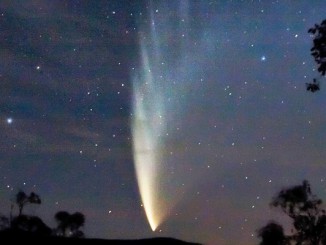
Comet impacts on Earth are synonymous with great extinctions, but now research presented at the Goldschmidt geochemistry conference in Prague shows that early comet collisions would have become a driving force to cause substantial synthesis of peptides — the first building blocks of life. This may have implications for the genesis of life on other worlds.
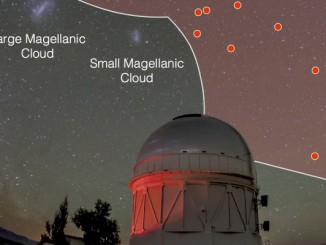
Scientists on the Dark Energy Survey, using one of the world’s most powerful digital cameras, have discovered eight more faint celestial objects hovering near our Milky Way galaxy. Signs indicate that they, like the objects found by the same team earlier this year, are likely dwarf satellite galaxies — the smallest and closest known form of galaxies.
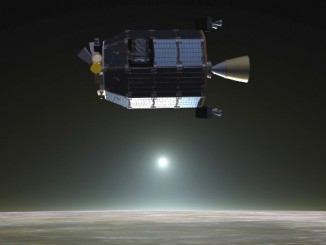
The Moon’s thin atmosphere contains neon, a gas commonly used in electric signs on Earth because of its intense glow. While scientists have speculated on the presence of neon in the lunar atmosphere for decades, NASA’s Lunar Atmosphere and Dust Environment Explorer (LADEE) spacecraft has confirmed its existence for the first time.
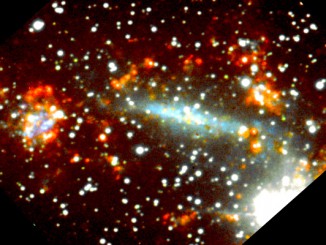
A spectacular galaxy collision has been discovered lurking behind the Milky Way, the closest such system ever found. “Kathryn’s Wheel” was found during a special wide field survey of the Southern Milky Way with the UK Schmidt Telescope in Australia. Such systems are very rare and arise from “bull’s-eye” collisions between two galaxies of similar mass.
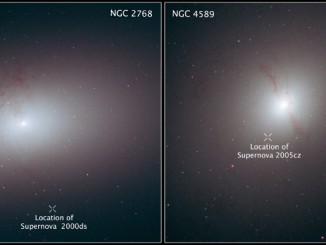
A new analysis of 13 supernovae — including archived data from NASA’s Hubble Space Telescope — is helping astronomers explain how some young stars exploded sooner than expected, hurling them to a lonely place far from their host galaxies. It’s a complicated mystery of double-star systems, merging galaxies, and twin black holes.

ESA’s Rosetta spacecraft has witnessed 67P/Churyumov–Gerasimenko make its closest approach to the Sun (perihelion) at 3:03am BST on 13 August, when the comet came within 116 million miles of our nearest star. Rosetta’s measurements suggest the comet is currently spewing up to 300kg of water vapour and a metric tonne of dust every second, creating dangerous working conditions for the spacecraft.

NASA’s Cassini spacecraft will zip within 295 miles of Saturn’s moon Dione on Monday, 17 August — the final close flyby of this icy satellite during the probe’s long mission. After close flybys of other moons in late 2015, Cassini will depart Saturn’s equatorial plane to begin a year-long setup of the mission’s grand finale: repeatedly diving through the space between Saturn and its rings.

The Gemini Planet Imager instrument has discovered and photographed its first planet. Dubbed 51 Eridani b, the body is a methane-enshrouded gas giant that is the most Jupiter-like exoplanet ever directly imaged, in a planetary system just 20 million years old. It may hold the key to understanding how large planets form in the swirling accretion discs around stars.
© 2026 Nebula Press Ltd