News


As the Moon slowly covers the face of the Sun on the morning of 9 March, a team of NASA scientists in Indonesia will be anxiously awaiting the start of totality. They plan to take 59 exposures of the Sun in just over three minutes, capturing data on the corona — the innermost parts of the Sun’s volatile, superhot atmosphere.

Scientists have long been puzzled about what makes Mercury’s surface so dark. The innermost planet reflects much less sunlight than the Moon, a body on which surface darkness is controlled by the abundance of iron-rich minerals. These are known to be rare at Mercury’s surface, so what is the “darkening agent” there?

University of Chicago scientists have discovered evidence in a meteorite that a rare element, curium, was present during the formation of the solar system. This finding ends a 35-year-old debate on the possible presence of curium in the early solar system, and plays a crucial role in reassessing models of stellar evolution and synthesis of elements in stars.
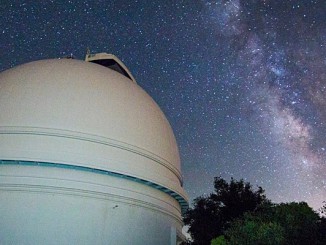
At the Palomar Observatory near San Diego, astronomers are busy tinkering with a high-tech instrument that could discover a variety of objects both far from Earth and closer to home. The Caltech HIgh-speed Multi-colour camERA (CHIMERA) system is looking for objects in the Kuiper Belt, the band of icy bodies beyond the orbit of Neptune that includes Pluto.
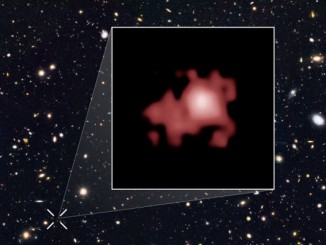
By pushing the NASA/ESA Hubble Space Telescope to its limits, astronomers have shattered the cosmic distance record by measuring the distance to the most remote galaxy ever seen in the universe. The galaxy, named GN-z11, has a redshift of 11.1, which corresponds to 400 million years after the Big Bang when the universe was only three percent of its current age.
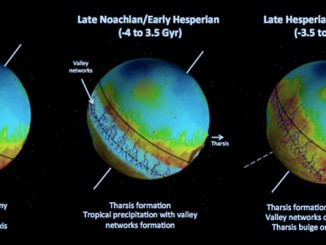
Mars hasn’t always looked like it does today. Some 3 to 3.5 billion years ago, the planet underwent a huge tilt of 20 to 25 degrees. The gigantic Tharsis volcanic dome, which started to form over 3.7 billion years ago, grew so massive that it caused Mars’ crust and mantle to swivel around, shifting the Tharsis dome to the planet’s equator.

Astronomers for the first time have detected repeating short bursts of radio waves from an enigmatic source that is likely located well beyond the edge of our Milky Way galaxy. The findings indicate that these “fast radio bursts” come from an extremely powerful object which occasionally produces multiple bursts in under a minute.
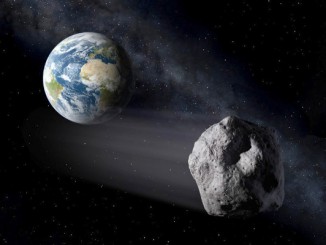
Discovered by the Catalina Sky Survey on 6 October 2013 a week before its last close flyby of Earth, 30-metre-wide asteroid 2013 TX68 was initially thought to pass by Earth again on 5 March 2016. Additional observations of the body have now been obtained, refining its orbital path and moving the date of the asteroid’s close brush with our planet to 8 March.
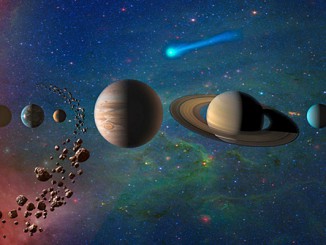
Since the 1700s scientists have known that gravity causes objects in the universe to get bigger, but the phenomenon of growth does not explain the hierarchy. Now researchers have proposed a new explanation for the size diversity: a universe that contains some big objects and many small objects relieves gravitational tension faster than a uniform universe.
© 2019 Pole Star Publications Limited